
Special Collections Spotlight Session September 2021
This month’s spotlight on elements of our special collections focuses on the weather. You can watch the video by clicking on the image below, and you can read the notes on the books further down this page. Enjoy!
It’s a well-worn cliché that the British love to talk about the weather (although I’m not sure it stops with those from our islands!) This is nothing new, and there are many books in the library’s older collections which revolve around the topic. This month we’ve pulled out four of these to examine.
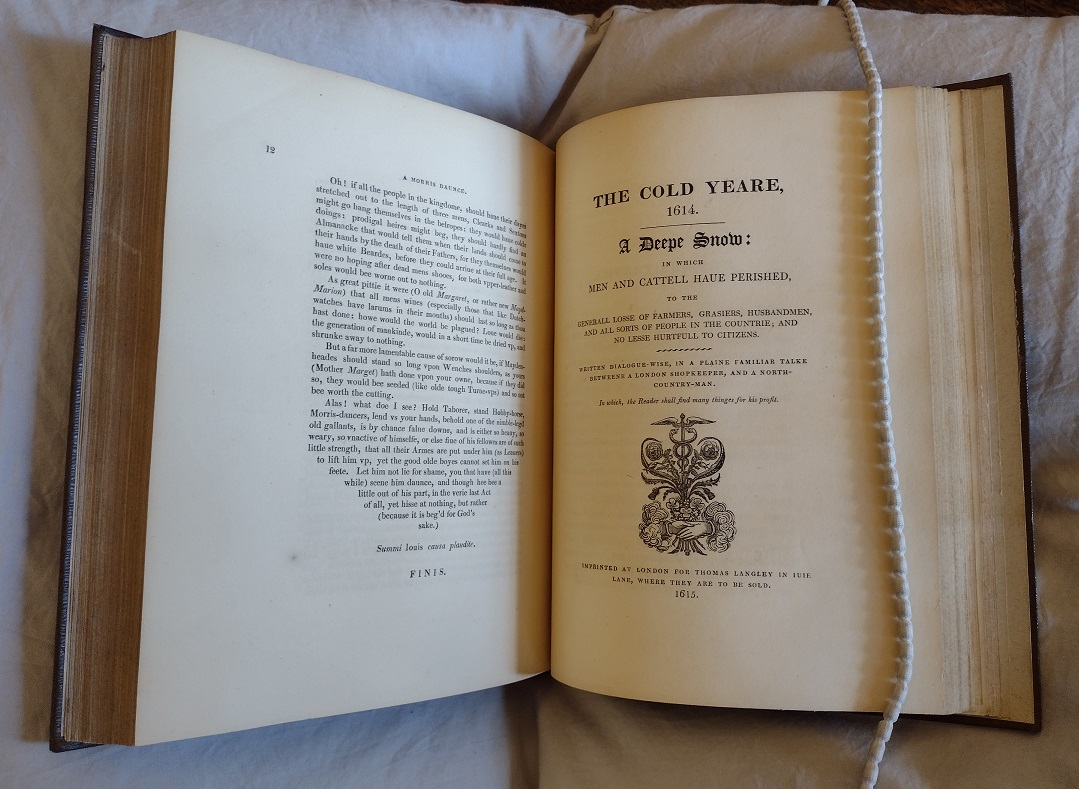
The first weather report is part of a larger work: ‘Miscellanea Antiqua Anglicana, or, A select collection of curious tracts, illustrative of the history, literature, manners and biography of the English nation, volume 1’ [Ca 248] was published in 1816. It is an anthology of older texts, purportedly gathered and reprinted from manuscripts. Each text has an introduction (under the title ‘Advertisement’) from the person who compiled the volume. The book was published for Robert Triphook, of London. Triphook was a book-seller and publisher, and his is the only name which appears on the title page, so it’s possible that he was the compiler as well, although that’s not specified. I also haven’t been able to find any mention of a second, or subsequent, volumes of this endeavour!
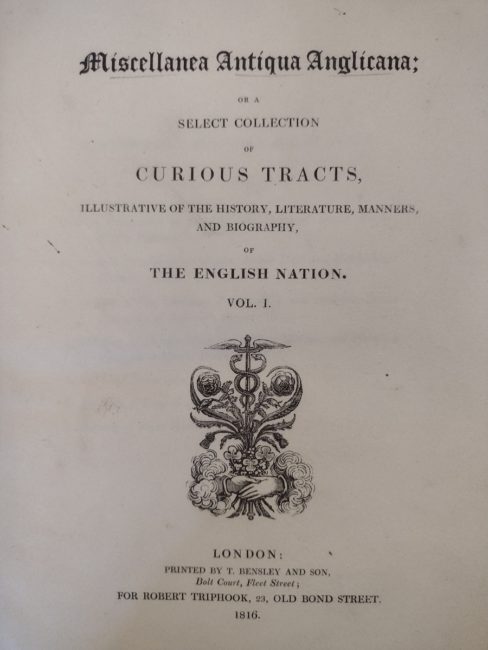
The particular tract of interest to our spotlight session is entitled (in modern spelling) “The Cold Year 1614; A deep snow in which men and cattle have perished, to the general loss of farmers, graziers, husbandmen, and all sorts of people in the country, and no less hurtful to citizens”. Here, the word ‘citizens’ is given to mean people living in urban environments, as opposed to the ‘country people’. The work is presented as a conversation between “a London shopkeeper and a North-Country-man” and describes the hardships endured by each as a result of the harsh winter of 1614-15.

Of equal interest, though, is the compiler’s justification for including this particular work in the anthology. They note that they had not intended to include anything related to a specific time or place, but that this tract might be of interest in “this most extraordinary season”. Noting that the ‘Miscellanea…’ was published in 1816 explains this comment, since that was the so-called ‘year without summer’, following the eruption of Mount Tambora in Indonesia the preceding year. The dust from the volcano obscured the sun over much of the globe, leading to extreme wet and cold weather. Many of the results of this were tragic, as people starved or succumbed to disease, but there were also some famous cultural outcomes, including the initial spark for Mary Shelley’s masterpiece ‘Frankenstein’.
The second book is ‘Weather Forecasting by Simple Methods’ by Francis S. Granger, published in 1909 [Bb 1728]. Granger was born in Nottingham in 1833, and is recorded in the census returns as a jeweller and watchmaker. He was also clearly interested in meteorology and weather observations, and at his death in 1912 he received an obituary in the Quarterly Journal of the Royal Meteorological Society. His rather pretty little book outlines methods for predicting the weather, mostly based on examination of the clouds and barometers, and is illustrated with examples from his own observations in Nottinghamshire. On its publication it was reviewed in the journal ‘Nature’, but the review was less than glowing! It denigrates Granger’s cloud classification, and implies that his is a rather parochial view, noting that “[…]the work may prove useful to local observers but it is doubtful to what extent some of the conclusions arrived at can be considered general.” Since we are based in Nottingham ourselves, though, the book could therefore still be useful to us!

This book also has links to Bromley House beyond its status as part of our collection. The author’s son, Frank Stephen Granger, was appointed as the first Professor of Classics and Philosophy at the University of Nottingham, in 1893, and he was a member of Bromley House. We have records noting at least one donation from Frank Granger, so maybe he also donated this copy of his father’s book. In addition, there is a note in our minutes that in 1891 8s 6d was paid to a Mr Granger for clock cleaning. Since Francis Granger was a jeweller and watchmaker, maybe this task was undertaken by his firm.
The third book under the spotlight this month is a very different type of work. It’s an official government publication entitled ‘Daily Weather Telegrams: forms and codes for use in Egypt’ [AS Dd 02792]. This manual was published in 1938 by the Ministry of Public Works of the Egyptian Government, and is printed English at one end and Arabic at the other. In 1938 Egypt was in a rather unusual situation; the country was previously part of the Ottoman Empire, and had been invaded by the British in 1882, but was never officially claimed as a British territory. Instead, it was a sometimes-official protectorate of the British state, although nominally independent. The British occupation continued, and the Anglo-Egyptian Treaty of 1936 confirmed that they had the right to station troops in Egypt to protect British interests in the Suez Canal. The British also continued to control the training of the Egyptian Army. So in 1938 Egypt was independent, but hugely under British influence, especially in matters of government and the military.
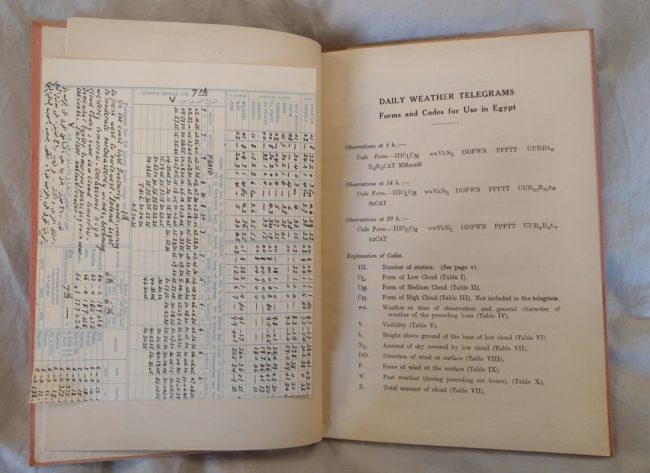
This book is a fascinating and slightly mysterious work, listing codes and their meanings, with descriptions of cloud forms and indicators of wind speeds. As with Granger’s book above, it places great emphasis on observation of the clouds, recommending that its users frequently refer to a separate Cloud Atlas to ensure accurate identification of cloud types. For modern weather observers, the World Meteorological Organisation’s current version of this reference can be found online at www.cloudatlas.wmo.int and includes hundreds of rather beautiful photographs!
The weather codes manual came to Bromley House as part of the Alan Sillitoe collection. (You can find out more about this collection in the Spotlight Session from February here: https://bromleyhouse.org/spotlight-on-alan-sillitoe/ ) We know that Sillitoe had a passion for maps and exotic locations, and that as a young man he also worked towards joining the military. He enrolled in the RAF in 1946, and trained as a navigator, serving in Malaya. The collection of his books which we hold in the library contains many handbooks and manuals, as well as military maps, and this weather guide fits well with this side of Sillitoe’s interests. It is a civilian document, but has clear geographical and military interest too.
There is a link, albeit rather tenuous, between the weather manual and the final book in this session, since the author of the latter spent time in Egypt during his own military career. This book is anything but military in tone, though! ‘A Country Calendar’ by Tickner Edwardes [Dd 3139] was published in 1928, and is a gentle and beautiful description of the weather and nature of each month of the year, as observed near the author’s home in Sussex. As well as masterfully conjuring the atmosphere of the landscape in each season, it’s also an interesting portrait of a rural way of life in the inter-war years.
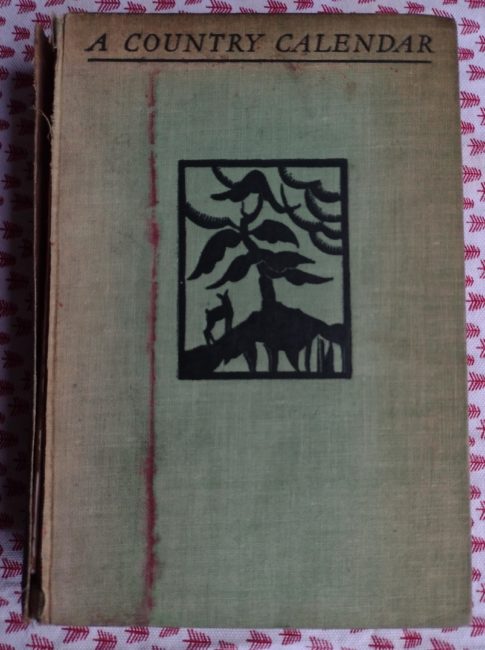
Edward Tickner Edwardes was born in 1865 and was a writer and naturalist, with a particular interest in bees and apiary. The two other books in our collection authored by Edwardes are, in fact, both about the art of beekeeping! During the First World War he joined the Royal Army Medical Corps (although he wasn’t a doctor), and served in Egypt and elsewhere. After the war he decided to train for the clergy and was vicar of Burpham in Sussex from 1927 to 1935, during which time he continued his observations and writings on nature. He stayed in Burpham on his retirement, and died there in 1944.

Tickner Edwardes by Elliott & Fry
bromide print, circa 1940-1944
NPG x89149
© National Portrait Gallery, London
All the books highlighted in this session are available for members to borrow.
Anja Thompson-Rohde