

Our February Special Collections Spotlight Session is a bit different to our previous ones: This month Sally introduces us to the collection donated to Bromley House by poet Ruth Fainlight, widow of writer Alan Sillitoe, following his death in 2010.
Due to the ongoing Covid restrictions, the session has been filmed and presented as videos, which you can find on our YouTube channel. You can watch all three videos back-to-back by clicking on the image below. The full running time is about 35 minutes.
An apology at this point: This was my first time behind the camera for one of these sessions and I think it will probably be the last, as my hands shake so badly! I’m really sorry for the ‘shaky-cam’ effect, which is especially pronounced at the beginning of each video – it does get (a bit) better as the videos go along. I hope this doesn’t ruin Sally’s excellent session for you. For those who can’t stand my shaky filmwork, or who prefer to read rather than watch anyway, Sally’s script is below too.
Anja
Today’s Spotlight falls on the Alan Sillitoe Collection. This is a real treasure, as it was the collection of books belonging to Alan and his wife, the poet Ruth Fainlight, which they had kept at their holiday cottage in Derbyshire. The collection was generously donated to Bromley House by Ruth, shortly after Alan died. He and Ruth had been joint Presidents of the library from 2009 to 2010.
Alan Sillitoe was born in Nottingham in 1928, and became one of the most influential new writers of the 1950s. In 1958, Saturday Night and Sunday Morning stormed into the public’s consciousness, when factory worker Arthur Seaton exploded from the pages of the book to become an icon of Nottingham’s literary heritage, and a key figure in the new wave of working class heroes. The story tells of his gleefully rowdy escape from the daily grind of factory work, through the streets and pubs of Nottingham’s Saturday nights. On Sunday mornings he recovers from the excesses of drinking contests, illicit affairs and beatings from irate husbands, by going trout fishing on the canals. The book retains its power to this day, and is still the best account of working class life in the 1950s that has ever been written.
Today, we’re going to be taking a close look at what is a very personal collection. Many of the books here contain messages and dedications from family, friends and fellow authors and poets, and there are notes written by Alan himself, which bring the writer’s presence very close when you read them.
The collection is presented as a library within the library, here in the Thoroton Room, which is the home of our local history and local writers’ Special Collections.
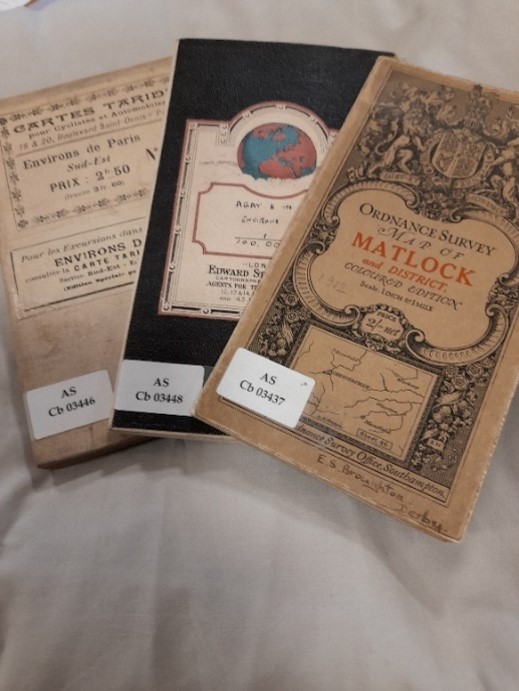
Alan and Ruth’s books are shelved in the same order of subject classification as they would be in our main library. Their interests were very wide, so all of the non-fiction subject classifications are here, in addition to a wide selection of fiction. There are also many maps. Maps were a recurring passion throughout Alan’s life, right from his childhood, and we’re going to begin this Spotlight by looking at his own maps and investigating their meaning to him throughout his life. The map cupboard behind me holds a huge number of these.
The beginning of Alan’s passion for maps is vividly described in his autobiography, Life Without Armour.
It seems that his fascination with maps originated as a means of escape from the harsh realities of his life at home, where violence was a constant presence. He and his mother were regularly thrashed by his father. Around the year of 1936, his father’s violent assaults were at their worst, and the little boy, aged just 9, understandably liked to spend as much time as possible with his grandparents, (his mother’s parents) who lived in a cottage in Wollaton.
Wollaton was rural countryside in those days, and in his memoir, Alan describes the smell of the cornfields, and of hearing the harvest machinery in the field outside, when he went to stay with his grandparents. Alan recreates the sights and scents of Wollaton in Saturday Night and Sunday Morning, when Arthur and Brenda go for a walk. They walk down Bramcote Lane, past the wheatfields, and there are “odours of wheatchaff” around.
It was while Alan was staying with his grandparents that he used to read the books that had been won by his aunts and uncles as Sunday School prizes. He began to see them not only as stories, but as a means of taking the mind, if not the body, to somewhere else, and would draw his own maps inside the covers and on the flyleaves of these books, to illustrate the places they had allowed him to visit in his imagination. He gave these places names, some of them were real, some were made up, such as Dreamland and Wonderland. Then he would check locations in the atlas, making a bridge for himself between what was real and what was his own invention.
When his grandfather saw these drawings of imagined lands, he gave Alan two Ordnance Survey maps, which he had in his sideboard, of the immediate location and area surrounding the cottage. Alan was now able to explore the countryside while charting his position against the gradients and landmarks of the maps.
Alan wrote of the way maps gave a sense of where he fitted in to the scheme of things. His home life was full of violence, with suffering and despair as its only reliable aspect. He wanted “even more than most, to belong on the map, though only under my own idiosyncratic terms.” The wider world view, offered by maps, of escape and adventure gave Alan a “form of deliverance from the enclosed world he was obliged to share with his father and mother.”
Alan himself writes: “The map of the world became my talisman, I had to know the whole world if my head at times wasn’t to burst from sheer misery”, and from the moment his grandfather gave him the old Ordnance Survey maps, the boy spent much of his time expanding his horizons through his new passion.
Back at his home, Alan used the scrag-end of a roll of wallpaper to draw on its back and make his own map. He drew a vertical line for the Greenwich Meridian, and a horizontal one for the Equator, and made a map of the world, marking with red crayon as many British Possessions as he could remember from his school atlas.
Travel, and books about travelling are a natural progression from a passion for maps, and Alan writes that when he went into town as a boy, he used to call in a travel agency, and would “beg, borrow or buy” travel brochures, with maps, plans and pictures of hotels in France and Switzerland.
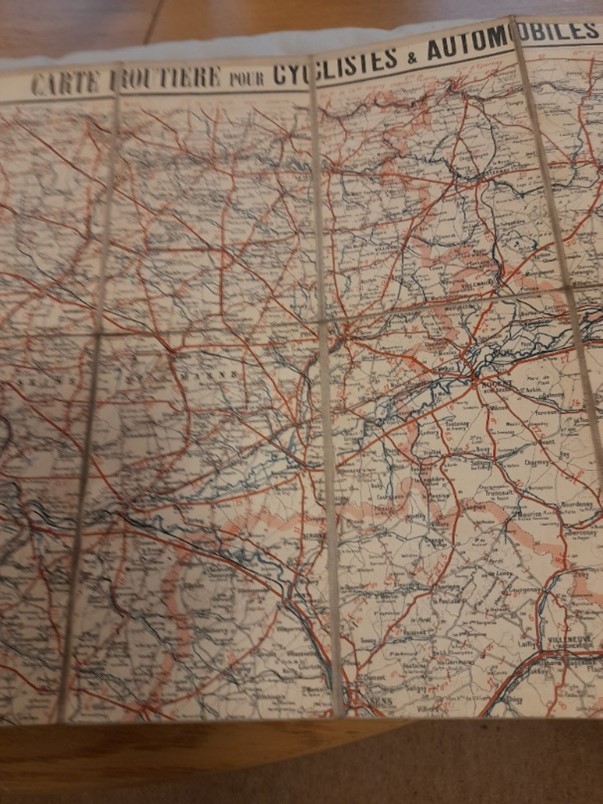
It was a passion that was to last a lifetime, and it is poignant today to see the multiple maps in the collection and to reflect on the part those earlier treasures from his grandfather’s sideboard had played in Alan’s life, and in his writing. They had allowed him to be creative, to expand the scope of what he could see and what he could dream, setting him on the road to becoming a writer, and it is fascinating to see the origins of his work in the obsession of a little boy, who found in maps an ordered world which he could make his own.
As a boy, Alan listened to the radio serialisation of the Count of Monte Christo. He was a regular visitor to the local public library, and read the Hunchback of Notre Dame, and all the William books, as well as Conan-Doyle, Rider Haggard and Jules Verne. He read his aunts’ and uncles’ books What Katy Did Next, John Halifax Gentleman.
His neighbours got to know of the boy’s love of reading books and maps. One gave him a tattered copy of Les Miserables, another gave him an Ordnance Survey map of Aldershot, while a third gave him a paper railway map of England. He was always on the look-out for new words, and was fascinated by the lists of foreign words and phrases that he found at the back of dictionaries, and on the maps.
The obsession with words is alive in the fiction section of this collection. The classics are here: Aesop; Bronte; Dafoe; Gaskell; Butler; Henry James, Fielding; Trollope. American writers are well represented: John Updike; Tom Wolfe, Scott and Zelda Fitzgerald; Melville and Willa Cather, as are the French: Balzac; Daudet; the Abbe Prevost. Polish, Russian, Bosnian, Italian and Lithuanian writers all have their place in the collection.
Alan left school at 14 and went to work at the Raleigh factory, where his father was working. Raleigh was at that time producing armaments as well as bikes, and at first Alan was involved in making shells, but was not happy when he was moved on to making bikes. He wanted to be more involved in the war effort, making weapons until he was allowed to go and fight. He had to be given permission to leave Raleigh by the Ministry of Labour, and was allowed to go to work for A.B. Toone and Co, a factory which made plywood for Mosquito bombers, and while working there he joined the Air Training Corps. His knowledge of maps meant that he could train as a navigator.
The war ended before he was eligible to join up, but he continued his with the ATC training, and at the age of 18, took a job as an air traffic control assistant, then began basic RAF training, which he soon completed, and became an RAF radio operator. In 1947 he was stationed in Malaya.
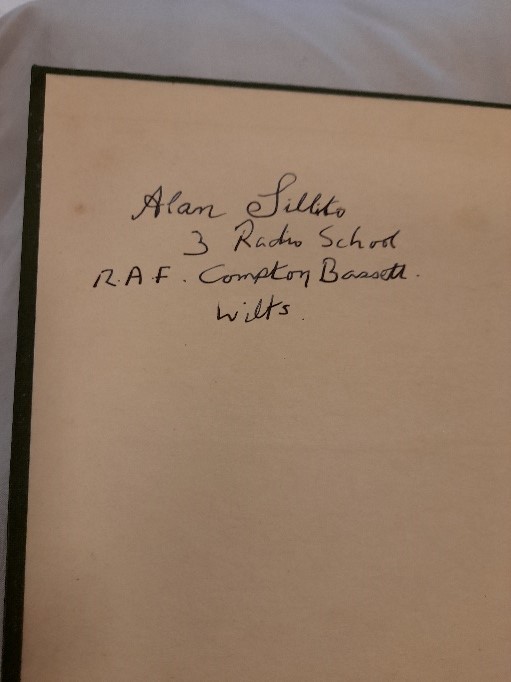
This part of his life is well represented here in the collection. We have the Handbook of Wireless Telegraphy, from his training course, complete with his handwritten address inside the front cover.
There is a Manual of map reading, Dd02776, and a boxed set of Electric and radio notes for wireless operators, published by the Air Ministry, Dd02787.
There is also a fascinating little volume, titled English for Airmen: an English course for air personnel, by Arthur Reginald Moon, 1943 Dd02781.
This was a book on English Grammar, written to help airmen write accurate notes and reports on missions. Its introduction explains that it has used extracts from reports on the Battle of Britain, and other military campaigns, in order to capture “the lads’” interest. It is an entertaining mixture of old school grammar, precis exercises, and adventurous and exciting accounts of earlier battles.
The passage taken from a report of the Boer War could have been written by Corporal Jones of Dad’s Army, with its references to the Mad Mullah, while the description of operation headquarters is straight out of a war film starring Kenneth More or Richard Todd. It begins: “A slim girl in WAAF uniform moves counters about on an immense table which was a map of England”, and describes: “girls shoving things about on the map with long poles.” Then, dramatically, “deft as croupiers, the girls raked some of the symbols from the map.”
It is a reflection of the times in which this book was written that when the WAAF servicewoman is introduced to the airmen reading and working from this passage, the first thing they find out about her is what her figure is like and what she is wearing.
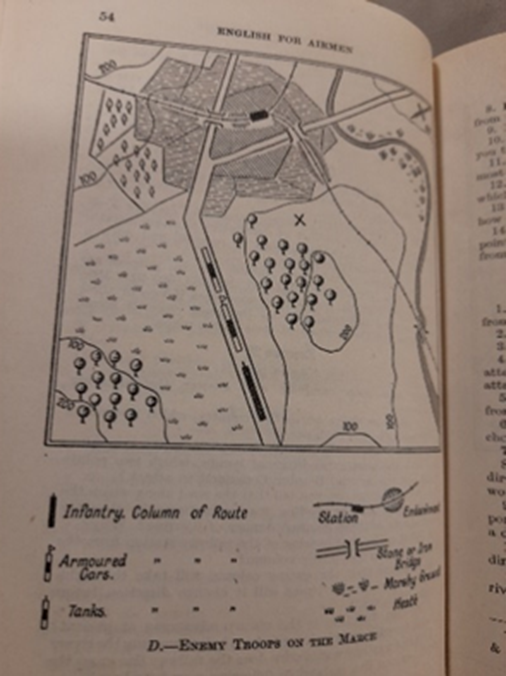
Nevertheless, it is an attempt to make a lively task out of what many of “the lads” no doubt found pretty dull, and contains maps and diagrams to break up the text.
Alan left Malaya and the RAF in 1948, when he was demobilised. He returned to England where he was immediately diagnosed as having tuberculosis. Both lungs were affected, and he spent 10 months from 1948 to 1949 in a sanatorium, where he underwent radical surgery to remove part of his lung.
Following this, he was forced to reconsider what his future might be. He qualified for an armed services disability pension, so he went back to live at his parent’s house in Nottingham, and embarked on a crash course of reading everything, from Greek to modern philosophy, Shakespeare, Wilde, Maupassant, Tolstoy, Turgenev, Dostoevsky, Dickens, Maugham, Shaw, Wells and Huxley. He bought himself a typewriter and began to write.
He moved on to stay in France, Spain and eventually rented a property with Ruth in Majorca, where they were able to live on his disability pension. They became friendly with the literary society on the island, including Robert Graves, and Alan completed the final chapters of Saturday Night and Sunday Morning there.
Alan and Ruth married in 1959, and became great travellers. In the years from 1978 to 1984 they visited Yugoslavia, the Netherlands, Belgium, Canada, Germany, Switzerland, India, Greece and Japan. The number of books in the travel section of the collection is huge, and has books ranging from the Antarctic to the Amazon, while in the natural history category, we have this attractive book: Bb 3455 Common Objects of the Riviera by I & H Chamberlain.

Other interesting titles in these categories include Bb3453 The Naturalist in Nicaragua by Thomas Belt; Cb03279 Forty Thousand Miles Over Land and Water, written by Ethel Gwendoline Vincent in 1886, and Cb03265 Beresford’s Monte Carlo: historical, analytical, anecdotal, informative, which is “the work of an authority” (the Hon. S R Beresford), and in a chapter described on the front cover as “masterpiece”, readers are informed of a diagnosis of how the casino card game of Chemin de Fer should be played.
Both Alan and Ruth were successful poets, as were many of their friends, including Ted Hughes and Sylvia Plath. The four of them met in 1961, when Alan presented a literary prize to Ted, after being awarded the same prize himself a year earlier, and discovered a similarity in their lives – Ted and Alan were both from working class backgrounds, while Sylvia and Ruth were both American-born poets, who had originally studied to be visual artists, before turning to poetry.
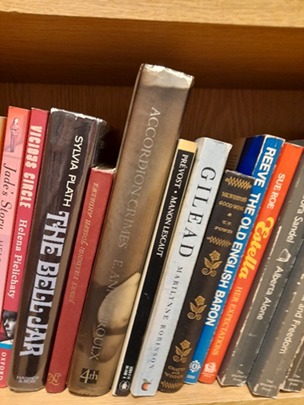
The Sillitoes were to remain staunch friends of Hughes, through the tragedies and criticism of his life, and we have books by them both Hughes and Plath in the collection.
Alan developed a lifelong connection with Judaism and with the Jewish people, and this is evident throughout the collection. There are many books here by Jewish writers, and a good many of these were personal friends of Alan and Ruth. Ruth herself was born in New York to Jewish parents. Her mother had been born in the Austro-Hungarian Empire, her father in London. Alan was in contact with Jewish intellectuals throughout his life, and was an ardent campaigner for the rights of Soviet Jews. He visited Israel, where he felt at home, several times.
Alan believed there was a sense of displacement as a state of mind in the Jewish people, which he felt he recognised and could identify with, in addition to being drawn to what he described as Judaism’s intellectual landscape. He writes of a story he read as a young boy, in a book he had borrowed from the library. It was a Russian tale in which a Jewish man was the only person to complete a task set by the Devil, and the young Alan was struck by the simple but clever ruse used by the Jew, and felt that he’d have done exactly the same thing. This was a very early example of his identification with Jews.
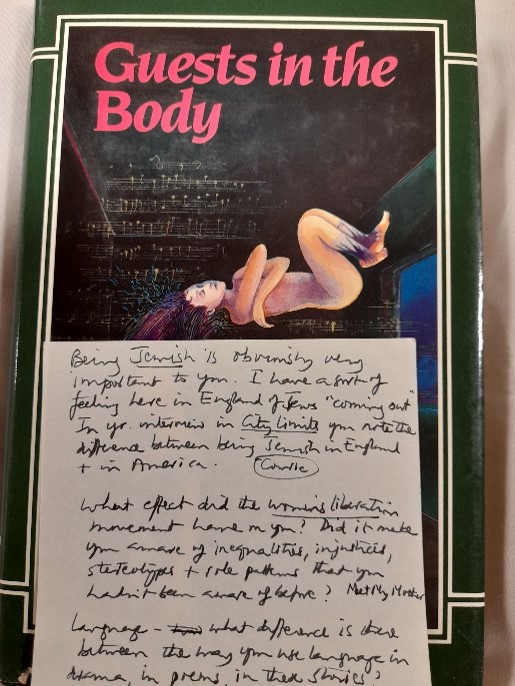
In the fiction section, there is a book by Michelene Wandor (1986), which is a collection of short stories about the Dybbuk, who was a restless invading soul of Jewish mythology. We have here a handful of notes, handwritten by Alan or Ruth to Michelene, analysing the stories, and asking questions about them. One of these reads:
“I think Michelene is the Dybbuk – she takes over these other beings, fits herself into them and speaks for them in these stories” while another note asks her about the Women’s Liberation Movement.
The fiction collection here illustrates exactly the same scope of boundless zest and interests as the non-fiction books. Inside many of these books are dedications and messages from Alan and Ruth’s family and friends, which you will find as you browse through the shelves, as well as the notes in Alan’s handwriting, some dating back to his days in the RAF, which really bring the collection to life.

In this copy of Brian Aldiss’s Earthworks, we find a birthday message to Ruth from the Sillitoe’s son, David.
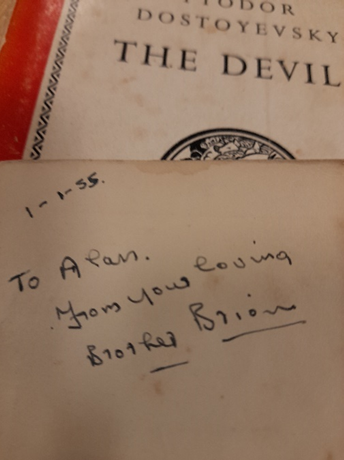
Here is a particularly interesting dedication. It is on the inside cover of the well-worn copy of Dostoevsky’s The Devils, and was written by Brian Sillitoe, Alan’s younger brother. It is exciting for fans of Saturday Night and Sunday Morning, to see his handwriting, because a good deal of the character of Arthur Seaton, and many of his exploits were based on Brian.
It is true that Alan worked at the Raleigh factory, described so memorably in the book, and Arthur’s exceptional speed at working the lathe is based on Alan’s own experience. In fact, Alan explains that he did this to beat the bosses at their own game. It was widely believed by the men working at Raleigh that the piece-work system had been devised to get as much work out of them for as little pay as possible. In the book, Arthur Seaton knows that if he works fast and does the job well, his mind can wander away from the factory, out into the countryside. He could also ease off in the afternoon and lark around with the girls. So, aspects of Arthur Seaton did have their origins in Alan Sillitoe himself. But he was only at Raleigh for a matter of months. He was only 14 when he started work there in 1942, and he soon fell into conflict with the managers, and wanted to move on.
If Alan survived at Raleigh for less than a year, his younger brother Brian worked there for many years, and he is considered to be as much a source of the character of Arthur Seaton as Alan, so it is a real privilege to see his affectionate message here, and to see the choice of book he made to give as a gift to his elder brother.
There is a book of short stories in the collection, written between 1934 and 1940 by T O Beachcroft, which is worth reading in its own right, but is also interesting to anyone who has read The Loneliness of the Long-Distance Runner, because both authors write about similar characters from similar backgrounds, some of the stories have similar themes – drunkenness and domestic violence for example. The language used by the characters in both books includes local accents and dialect.
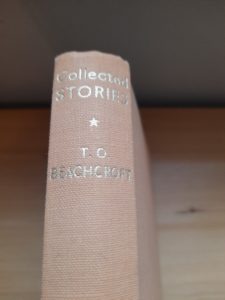
Beachcroft’s stories tend to be somewhat whimsical, often with a sort of wry twist at the end, which has the effect of draining the punchy impact of the main body of the narrative. Both he and Alan wrote a story which ended with a drunken woman being involved in a traffic accident.
In Alan’s story, he examines and exposes an entire life, with all its moments of forgotten happiness and lost love, and loneliness and heartache, through the narration of a single fragment of that life.
Beachcroft’s story has no such ambition. It is complete in itself, its whole narrative is driven towards the twist at the end. It is clever and self-contained, and its characters exist within the frame of its narrative for the simple purpose of the story’s denouement.
Beachcroft’s stories were described as “inoffensive,” which was not the way Alan’s books were received. A Nottingham Labour councillor in the 1960s attempted to have Alan’s books banned from local libraries. He was unsuccessful.
In this Spotlight session, we have followed the course of Alan Sillitoe’s life, from his childhood in Radford, Nottingham, to his status as an iconic writer of worldwide acclaim, by looking at his personal collection of books and maps. Yet Alan was famously curmudgeonly about being labelled or classified, and ultimately it is impossible to resist the temptation to close with Arthur Seaton’s manifesto:
“I’m me and nobody else; and whatever people think I am or say I am, that’s what I’m not, because they don’t know a bloody thing about me”.