

As library members will know, our collection of books is organised into classmarks, or sections, each given an identifying letter to which running numbers are appended to provide a unique identifier for individual books. The system of classmarks was developed when the library was founded – 60 years before Melvil Dewey published the classification system used in most modern libraries. It is therefore somewhat idiosyncratic! It is also rather interesting, however, and the order of the different topics within the alphabetic letter system can offer some insight into the priorities and interests of the library’s founding members. Fiction (Dc), for example, doesn’t even have its own letter code, being a subset of letter D, together with Literary Criticism (Da), Poetry & Drama (Db), and Miscellanies (Dd).
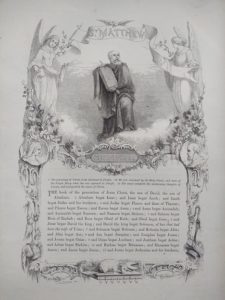 The classmark at the top of the list, therefore, could be interpreted as the one which was of primary interest to the early librarians. Classmark A denotes the theology collection. This has clearly been a topic of great import in the history of the library, but in recent decades it has become less frequently used and rather overshadowed by other sections of the collection. One of our library members, Stephen Bates, took an interest in this somewhat neglected area of the collections, and has recently completed a mammoth voluntary project to investigate it further. Here is his introduction to the project:
“In March 2018 there was a small social gathering to celebrate the re-binding of some of the books from the historic collections of the library. As I had contributed to this, I was invited. I fell into conversation with Katie (then a newly-appointed staff member) and we discovered a common interest in the Theology Collection. The idea emerged that I should undertake a book by book examination of the collection and place the books thematically; these themes were to reflect the interests and concerns of the membership throughout the nineteenth, and the first half of the twentieth, century.
 There were approximately two thousand books to consider. They could be described as the library’s foundational collection, and what a fascinating group they are! They were donated and bought by the clergy who met (with others) to start the library.
Over the next two years, this audit was done, book by book; commentaries, polemic, apologia, spirituality, plus ten other categories; all in the attics of pre-restoration times! This was the first stage of what I hoped would be three: reinterpret, relocate and repurpose.
The results were recorded in what we came to call “The Yellow File”. This is now placed with the collection in the New Reading Room, and I hope it might assist members – an initial “Guide to the Perplexed”, as the titles and appearance of these books can be very deceptive!
I would like to thank the staff for their support – particularly Katie – bearer of heat and light in the chilly attics! Melanie and Anja have also offered welcome advice, encouragement and support.”
We are hugely grateful to Steve for his efforts in this project and the output is fascinating and helpful. As he mentions, The Yellow File is now available for anyone to browse – I have put it at the start of the classmark A books, to the right of the door when you enter the New Reading Room.
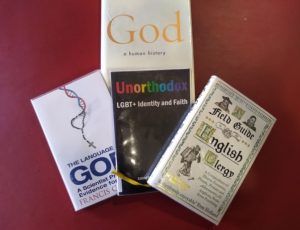 The first two of Steve’s aims have now been achieved: He has reinterpreted the collection, allowing us to see easily what themes and types of work it covers. We have also relocated the collection, moving it as part of the refurbishment of the attic floor, so that it is now more accessible in the New Reading Room, and more comfortable to browse, being in a much warmer place than before!
This is only the start, though. Steve’s third aim was to repurpose the collection, by which we mean that we want to explore, together with our library members, how we can use it differently. The first stage of this will be to give it a bit of publicity, letting everyone know what fascinating items are waiting to be discovered. Steve’s yellow file will certainly help with this, and he has also very kindly agreed to provide information on one of the topics he researched for one of our Special Collections Spotlight Sessions. You can find details of this here, and look out for the videos and notes of the session on our website and YouTube channels around the end of November, introducing you to the life and work of Evelyn Underhill, which is well represented in the collection.
We hope that this will pique your interest in this intriguing part of the collection. If so, maybe you would be interested in meeting other library members to chat about it? We would like to gauge how many of our members would be keen on an informal discussion group on matters of philosophy and theology, in some form, based on items in the library collections but encompassing wide-ranging topics. It might be an electronic group, meeting by video conferencing, or via an online forum or email thread, or in the post-Covid future it could be a group meeting in person in the library. A number of different formats and approaches are possible; we’re throwing ideas around at the moment and would love you to be involved in that! Email anja.rohde@bromleyhouse.org if you’d like to know more.