

The Special Collections Spotlight Session for May is presented in video format again! The videos are on our YouTube channel. You can watch each one separately, or you can see all five back-to-back in a playlist here: https://www.youtube.com/playlist?list=PLVcBCQNhIkUZJhED2Cp1U7fNld-2pM-Ns
For this month’s Spotlight Session we focus on one of the named Special Collections in the library: the items donated by James Ward. This is one of our most interesting and unique sets of books, so this will certainly not be the only Spotlight Session to look at this collection! The four books chosen for this first event, however, give an introduction to the range of works which James Ward donated.
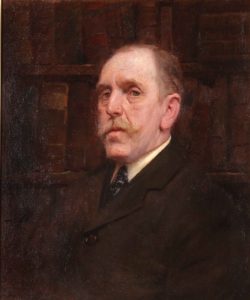
“James Ward of Nottingham, in a library” by Harold Knight (1902)
James Ward was born in Nottingham in 1851, and lived here until his death in 1927. He was educated at Cleveland House Academy, in Nottingham, and was then apprenticed to his father, who was a bootmaker. From 1871 he attended the Derby Road Baptist Church, and he became the librarian of the church school, a position he held from 1883 to 1899. He was also very active in the social and intellectual life of the city, being a founder member of the Thoroton Society, as well as being active in the Nottingham Mechanics Institute and at the Nottingham Castle museum and art gallery. He was a member of Bromley House from April 1906 to December 1918.
James Ward developed a reputation, both locally and nationally, as a bibliophile, collector, and bibliographic researcher. He had wide range of interests and collected books and artworks across many subjects. He was generous with loans and donations of his collections, and he began to donate works to Bromley House in 1899. His major contribution to the library’s collections, however, came in 1914 when he gave his entire set of local history books. These have been kept together ever since, as the James Ward Collection.
The collection of Ward’s books is fascinating, and it is also unique, due to his habit of ‘scrapbooking’. He would sometimes get the published works which he owned rebound to include extra blank pages, and then use those pages to collect additional ephemera related to the published work, such as newspaper cuttings, correspondence, tickets, or pamphlets. He also kept a number of more conventional scrapbooks, sticking items of paperwork into the pages of blank books. The first item in this spotlight is one of these scrapbooks.
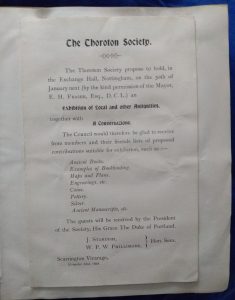 This hardbacked book in a marbled cover contains a number of items relating to the work of the Thoroton Society and the Mechanics Institute [JWC/3 (181)]. The items from Thoroton date from 1898 to 1906 and seem to mostly be blank copies of correspondence which the society sent out. They include forms asking people to lend items for various exhibitions and conversaziones which the society intended to hold, together with confirmation of loans, tickets, and letters of thanks, all blank. The scrapbook seems to be an administrative record of the actions of the society, and this borne out by some of the newspaper cuttings which are also included; James Ward is named as part of the committee which organised the exhibitions, so it would be logical that he would hold the file of their mailings. The Thoroton Society was created in 1897 to study and promote the local history of Nottingham. The first exhibition mentioned in the scrapbook is to be staged in January 1899, less than 2 years after the formation of the society, so these papers are an interesting insight into their very early activities. Similarly, there are papers relating to the organisation of two exhibitions by the Mechanics Institute: the 75th anniversary display in 1912, and their exhibition about Byron in 1915.
James Ward had many interests but a major subject of the books in the collection is local history. One of these books is “The Peak and the Plain: scenes in woodland, field and mountain” by Spencer T. Hall “The Sherwood Forester”, from 1853 [JWC/1 (16)]. It’s a series of short articles on local places and legends. It includes descriptions of towns, landmarks, stories, wildlife and landscapes, in both prose and poetry.

The author, Spencer T. Hall, was born in Sutton-in-Ashfield in 1812, and trained to be a printer here in Nottingham. After his training, he ran a printing and bookselling business back in Sutton-in-Ashfield, but he also published newspapers and magazines, often including his own work under the pseudonym ‘The Sherwood Forester’. The vignettes in this book were originally written for the Sheffield newspaper The Iris, and were then collected and expanded into this volume. Hall has a connection to Bromley House too, and it’s from a much more unusual source! Throughout his life he was interested in what we would now call alternative medical therapies, being part of various phrenology societies, and teaching himself mesmerism. He practised as a therapeutic mesmerist, and around 1852 he also became a homeopathic doctor. He wasn’t a member of Bromley House, but it’s recorded in our archive that in the 1830s he came to the library to give lectures on phrenology!
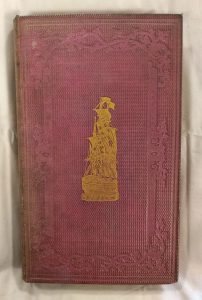 The third book in this Spotlight Session shows James Ward’s interest in travel and history further afield, and it also offers a personal insight into his life. This rather beautiful purple volume is “Journal of 3 Voyages Along the Coast of China in 1831, 1832, and 1833; with notices of Siam, Corea and the Loo-Choo Islands”. (Siam is now Thailand, and the Loo-Choo Islands are the Ryukyu Islands of Japan.) It was written by Charles Gutzlaff in 1834, and this is the 3rd edition, published around 1840 [JWC/2 (75)]
Karl Gützlaff (anglicised on the title page of the book) was a German Lutheran missionary, who undertook missions to East Asia in the early 19th century. He worked on a Chinese translation of the bible, and set up a school for “native missionaries” to take the Christian message to the interior of the country, where foreign visitors were not welcome. He was an interpreter to the British during the First Opium War in 1839-42, and he became the Chinese Secretary to Hong Kong in 1842. He was renowned in missionary circles for his attempts to integrate into local societies, and the frontispiece of this book shows him in the dress of the Fujian province of South-West China. This third edition includes a prefatory essay by Rev. William Ellis, who undertook missions to Hawaii and Madagascar.
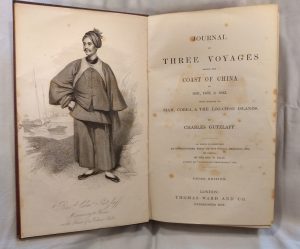 The book has additional interest because of its dedications. On the flyleaf is a handwritten inscription presenting the book to Master J. Ward on the occasion of his leaving school at Midsummer 1865. It is signed from “his affectionate friend and tutor, Gregory Porter”. Gregory Porter ran the Cleveland House Academy in Nottingham, which James Ward attended. He would have been 14 when he left school in 1865. It is clear that he also held his tutor in some affection too, as the page behind the flyleaf has a plate stuck onto it reading “In loving remembrance of Gregory Porter, who died on Thursday, August 29th, 1889, in his 61st year”. This was nearly 25 years after the book was presented to James Ward so it’s quite touching that he took the trouble to add the memorial into it after all that time.
The final items examined here are a set of three books written by local artist, poet and brushmaker William Kiddier (1859-1934). Kiddier was born in Loughborough in 1859 but spent most of his life in Nottingham. His father was a brushmaker, and William followed him into that trade. He was also a talented artist and illustrator, creating both pen and ink sketches, and oil paintings. Some of his paintings were exhibited at the Royal Academy in London. However, around 1919 or 1920 he became dissatisfied with his work and burnt all the unsold canvasses which he still had in his studio. He then went on to develop a new style for his painting, which is rather impressionistic, and focuses on bright, vivid colours. Examples of these later works can be seen in the collections of Nottingham Museums, and at New Walk Gallery in Leicester, amongst others.
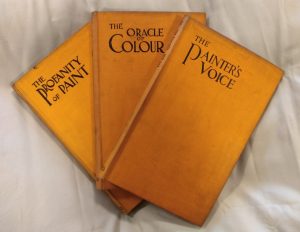 “The Profanity of Paint” [JWC/1 (17)] was published in 1916, “The Oracle of Colour” [JWC/1 (18)] in 1918, and “The Painter’s Voice” [JWC/1 (19)] about a year later. They are books of short musings, sometimes only a single paragraph, on the importance and role of colour in painting, and in some ways they may be an attempt to articulate Kiddier’s dissatisfaction with his earlier art, and presage the development of his later style. The first book has a handwritten inscription to James Ward.
The books highlighted in this session are not for loan, but are available for members to read in the library. The majority of the James Ward collections is housed in the Thoroton Room, on the bookcases to the left of the fireplace, and can be taken from the shelves to read, once we are back in the library.
Anja Thompson-Rohde