
Special Collections Spotlight Session January 2022
It’s been a while since our last Spotlight Session highlighting some of the treasures from our Special Collections. We’ve got a good one for this first session of 2022, though; join Anja as she examines some books including folklore, myths and legends. You can watch the video of the session by clicking on the image below, and you can read the notes on the books further down this page. Enjoy!
For the first Spotlight Session of 2022 I’ve gathered a few of the many books in the collection which relate to myths and legends. Some of these are known the world over, while others are more local in origin, and the books represent a variety of different approaches to these tales.
‘Classic Myth and Legend : with illustrations in colour and monochrome from famous paintings and statuary’ [Cc 1658] was written by A. R. Hope Moncrieff, and published around 1912. It is a rather beautiful book, with a green bookcloth cover, embossed, inked and gilded in an elaborate Art Nouveau design which extends over the spine. The interior detailing is also in this early 20th century style, and the book is lavishly illustrated with plates showing contemporary and ancient art. It begins with a section discussing the nature and development of myth, and then goes on to recount various legends from the pantheons of Ancient Greece and Rome. It is interesting that when this book was accessioned into the library collections it was classified in the Cc section, which is history and antiquities, rather than the fiction section!
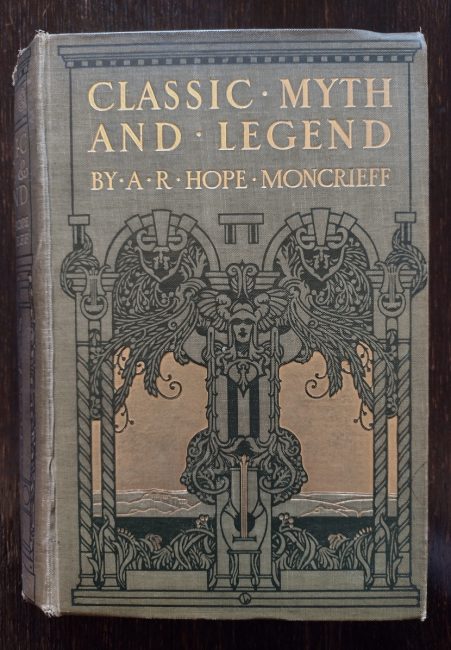
A. R. Hope Moncrieff was one of the pseudonyms of Robert Hope Moncrieff, who was born in Scotland in 1846. He was a prolific writer from a young age, and is especially remembered for his children’s fiction, although he also wrote short stories, novels, translations, guides, encyclopaedia entries, and educational reference works for both adult and younger audiences. His output included a number of the ‘Black’s Guides’ – accessible travel guides published by Adam and Charles Black of Edinburgh. We hold two of these in the collection: Derbyshire [Cb 03297] and The Peak Country [Cb 2893]. Moncrieff died in 1927, at the age of 81.
The second item under the spotlight is a set of four books on “The Traditions of Lancashire”. These were written by John Roby, who was born in Wigan in 1793. He worked as a banker, but also had an interest in local history, and in 1829 he published the first two volumes of this set [Dc 239 & Dc 240]. These were incredibly popular, and were followed by a second series in 1831 [Dc 241 & Dc 242]. The books contain various tales, poems and legends, each preceded by an introduction from Roby. Roby himself has sometimes been cited as an early folklorist, but the books are not, strictly speaking, folkloric records, since he embellishes and interprets the tales as narrative stories, rather than simply setting them down as heard. Indeed, these books have been classified in the Dc section of our collection, which is for novels and other fiction.
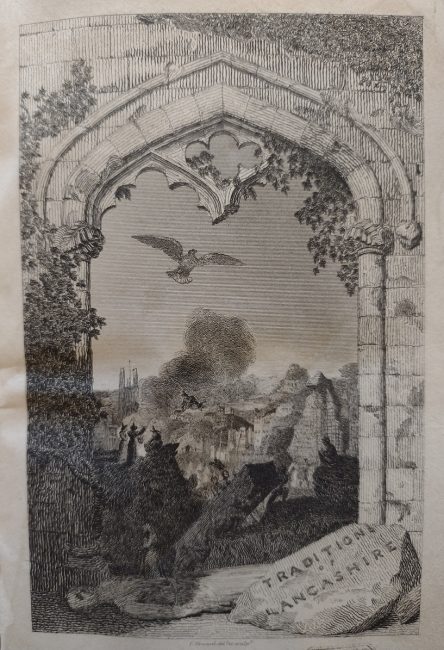
Both series of “The Traditions of Lancashire” include a number of monochrome plates showing engravings of the landscapes and buildings referred to in the tales. These were drawn by G. Pickering and engraved by Edward Finden, and are rather beautiful. All four volumes include the title page shown here, with its scene of witches on a wild crag, viewed through a ruined gothic archway. The plates are individually stamped with the library’s monogram (“N. S. L.” for Nottingham Subscription Library) in order to help prevent unscrupulous readers cutting them out of the books and selling them as individual pictures; there was a good market for these in the 19th century (and to a certain extent there still is!).
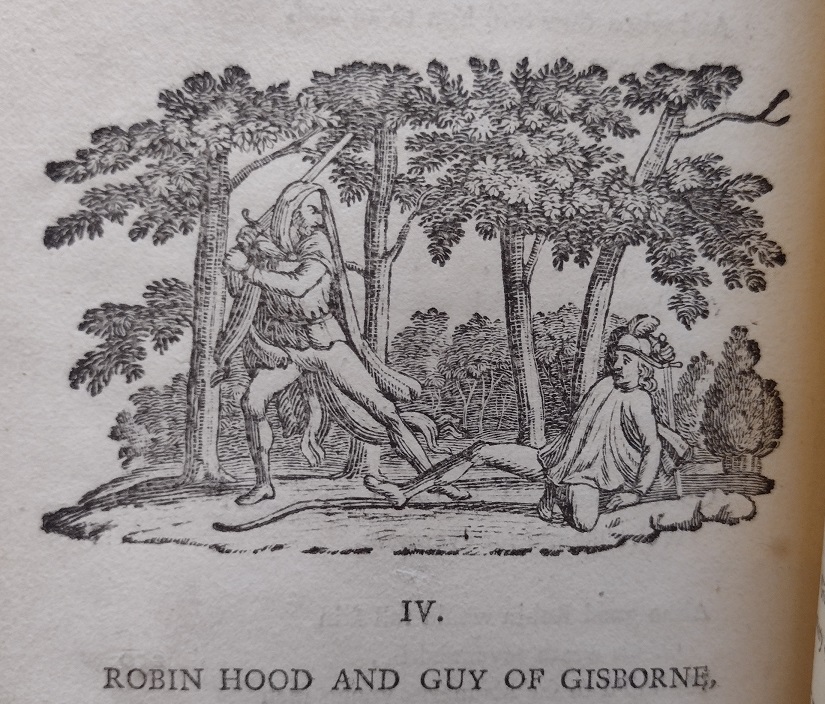
Any discussion of myths and legends in a Nottingham library collection wouldn’t be complete without mentioning Robin Hood! He is here represented by “Robin Hood: a collection of all the ancient poems, songs and ballads now extant, relative to that celebrated English outlaw : to which are prefixed historical anecdotes of his life”, edited by J. Ritson, with wood engravings by Thomas Bewick, and published in 1795 [Db 1158 & Db 1159]. This two-volume set is bound in mustard-coloured leather, with embossed and gilt patterning on the corners and around the inside of both covers. The books were rebound in 2003 by Cyril Formby of Ramsbottom, and the records note that he reused the original boards, but gave the books new leather spines, which were blind tooled and gilded “in 18th century style”. They are a very handsome set!
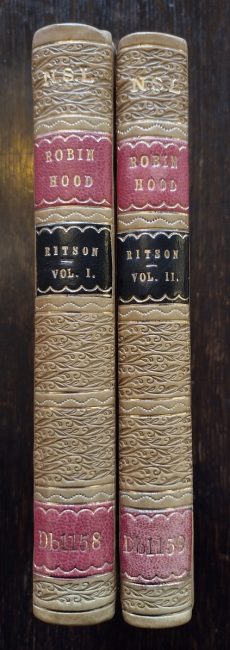
John Ritson was an antiquary and author, born in Stockton-on-Tees in 1752. He trained for the law, which took him to London in his early 20s. He started writing in the 1780s, becoming famous for his literary criticism and scathing attacks on the errors he found in his contemporaries’ collections and translations. He seems to have been a rather eccentric character, described as cantankerous and difficult to get on with, as his vicious criticism of others’ work shows. He devised his own reformed version of English spelling, and was also an early advocate of vegetarianism, for both moral and health reasons. He died in 1803, aged 50, after suffering a psychological collapse.
As well as commenting on contemporary publications, Ritson also published his own edited collections of songs, romances, and poetry, and he is most renowned for this collection of items relating to Robin Hood. For this work, he gathered all the texts he could find about the outlaw, and the set is particularly notable as being the first publication of what is generally regarded as the earliest extant reference to the character, ‘The Lyttel Geste of Robyn Hode’, dated to around 1450. It is also one of the key publications in the development of the modern myth of Robin Hood, as Ritson was one of the first to ascribe altruistic motives to the outlaw; previous stories usually had him stealing from the rich then keeping for himself, rather than giving to the poor! Ritson starts his collection with a chapter of ‘facts’ about the life and character of Robin Hood, suggesting that he considered the outlaw to be a genuine historic personality. The character which he ascribes to Hood bears many of the elements of Ritson’s own political leanings, being something of a revolutionary, and being portrayed less as a criminal outlaw and more as a freedom fighter; a tradition which was continued and embellished by later authors such as Sir Walter Scott and Thomas Love Peacock.
Thomas Bewick (1753-1828), who created the engraved illustrations for the book, was also an author in his own right. He mostly wrote illustrated works of natural history, and is especially noted for ‘A History of British Birds’, published between 1797 and 1821. We hold an 1826 edition of this work in the library [Bb 842 & Bb 843].
The final work in this spotlight session looks at two legends specific to Nottingham. These are included as appendices in “Walks Round Nottingham” by ‘A Wanderer’ from 1835. We have four copies of this work, but the one included here is part of the James Ward Collection [JWC/2 (95)] ‘A Wanderer’ is a pseudonym of Matthew Henry Barker, who was born in Deptford in 1790. In his youth he served at sea, first with the East India Company, and then with the Royal Navy. In 1825 he became a journalist, initially editing a paper in the West Indies, before moving to Nottingham two years later and starting an eleven-year stint as editor of The Nottingham Mercury. In his later life he published books of nautical tales under the pseudonym ‘The Old Sailor’. “Walks Round Nottingham” grew out of a column in the Mercury, and includes descriptions of six walks which Barker took from Nottingham out to the surrounding areas, many of which are now suburbs of the city but were still rural towns and villages in 1835. The book then includes three appendices, one of which is an account of the riots in the city following the rejection of the Reform Bill in 1831, just four years before the book’s publication. The other two are accounts of local legends: “The Fair Maid of Clifton”, and “St Ann’s Well”.
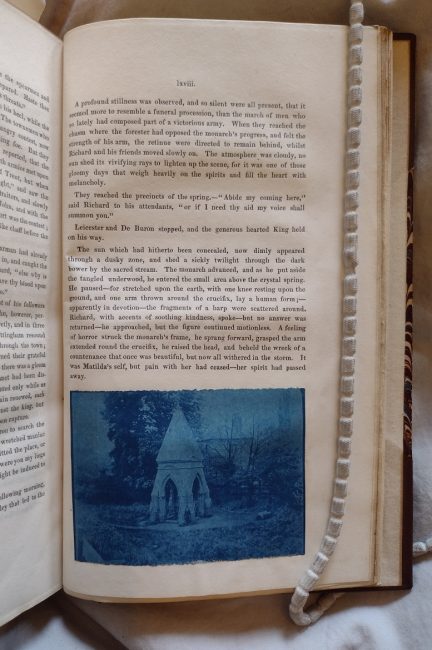
“The Fair Maid of Clifton” was a relatively well-known tale beyond just the local Nottingham area. It was the basis of a 17th century play by William Sampson (“The Vow Breaker, or the Fair Maid of Clifton”), and Henry Kirke White included a version of the story in his 1803 collection “Clifton Grove; a sketch in verse, with other poems”. The tale tells of a beautiful girl, most commonly called Margaret, who pledges her love to her beau Bateman on the eve of his leaving Clifton in the service of his lord. Shortly after he departs, Margaret is forced by her father to marry a wealthy local man, and when Bateman returns he is broken by her inconstancy and kills himself in despair. Margaret generally either goes mad, also commits suicide, or both. “St Ann’s Well” tells the story of a mysterious knight, who turns out to be King Richard I, returning from the crusades in disguise. He comes to the well, and there meets a ‘maniac woman’ who he eventually recognises as the noblewoman Mathilda, who he knew before he left England. She has been badly mistreated by his evil brother Prince John, and forced into exile in the woods. Richard and his retinue then attend a tournament which John is holding at Nottingham Castle, where they defeat and humiliate those responsible for Mathilda’s fate. At the end of the tale, Richard returns to the well, where he finds Mathilda dead, clasping the crucifix which is set up at the site.
St Ann’s well was a natural spring near Nottingham whose water was reputed to have healing powers. It flowed into an underground chamber and people in need of its help would come and either sit in the water, or drink it. In 1409 a chapel dedicated to St Ann was built at the site of the spring, and it was thenceforth also named in her honour. However, from at least the 16th century it was sometimes instead referred to as Robin Hood’s well, and there are reports that the site housed a chair, an iron helmet or cap, and a horn which were reputed to have belonged to the outlaw. In the Victorian period the underground chamber was blocked off, and a gothic folly built over the well. This seems to have been destroyed in the 1880s during construction of the railways. The district of Nottingham where the well was situated is still called St Anns. The copy of “Walks Round Nottingham” from the James Ward Collection includes a small cyanotype of the Victorian folly, which James Ward has pasted onto the last page of the appendix containing the relevant story.

All the books highlighted in this session are available for members to borrow, with the exception of the James Ward copy of “Walks Round Nottingham”. Other copies of this book are available to borrow, though.
Anja Thompson-Rohde