
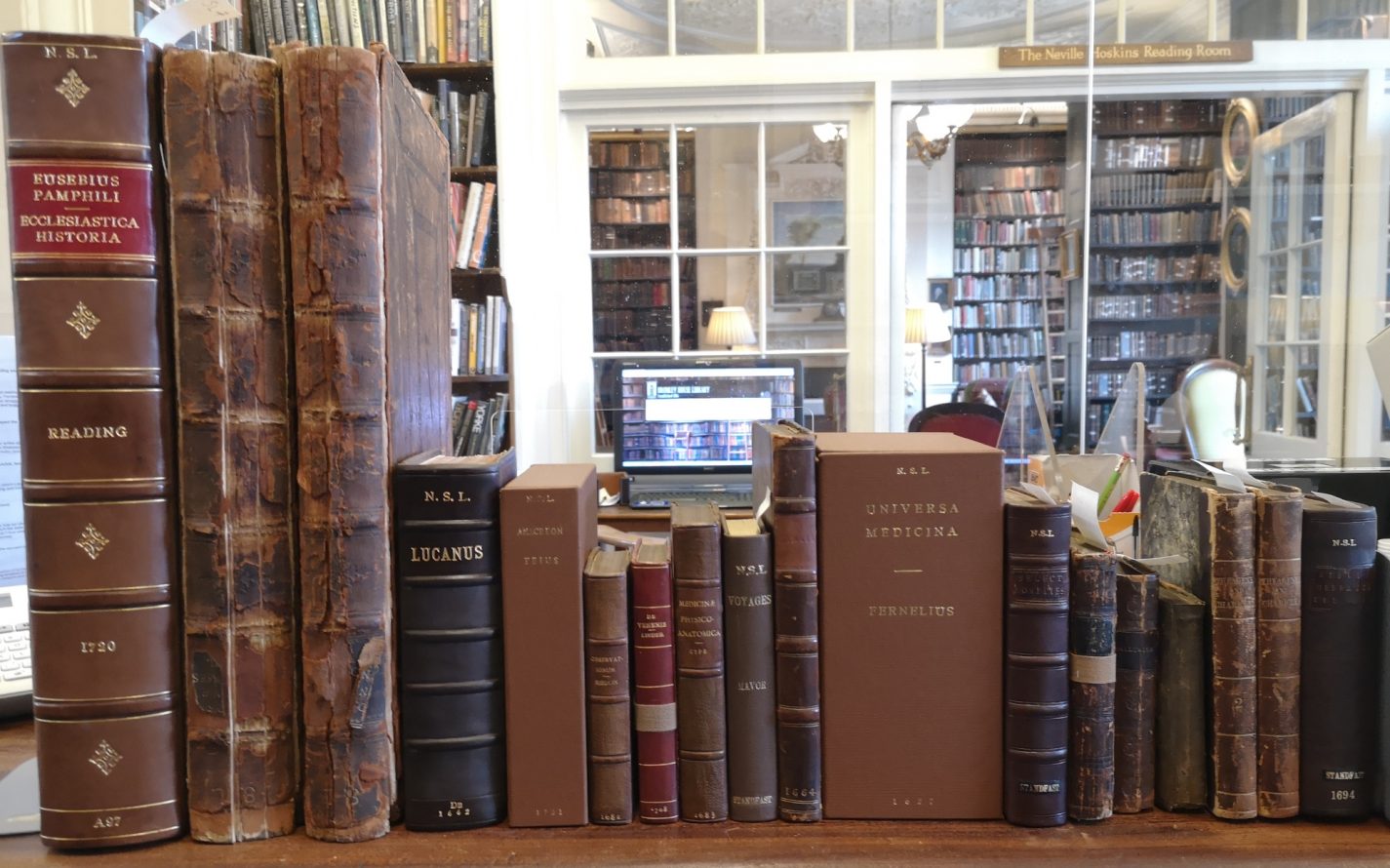
A while ago we received an enquiry from a non-member, whose distant relatives had been members of Bromley House in the mid 19th Century. Checking through the Standfast Ledger (the oldest of our old borrowing ledgers), we could see the books his great-great-great grandfather had borrowed in the 1840s. We know that, due to financial pressures, the Library has had to sell a fair proportion of its historic stock over the years, including the vast majority of books from the historic Standfast Library, but it was still surprising to note how few of the books our founding members were reading are actually still in the building today.
Below we have gathered together some of these sold, discarded or otherwise absent books that have been digitised by other institutions. Though we can’t feasibly return these books to the library in their physical form, at least not permanently, we can still enjoy them and recognise them as a part of our historic collection today. Below we’ve listed five books that used to form a small part of our collection at Bromley House, and you can view digitised versions of these books by clicking on the relevant links. Five down, several thousand to go…
N.b: Due to the ill advised practice, in years gone by, of numbering all of the books by size, the shelfmarks below are no longer accurate with regards the modern collection.
Contents:
- Bb 8: Flora Londinensis
- Bb 11: Pharmacopoeia Londinensis (Standfast Library)
- Bb 20: The Art of Glass (Standfast Library)
- Bc 136: The Anatomy of the Brain (Standfast Library)
- Cb 10: Relationi Universali (Standfast Library)
 Title: Flora Londinensis, or, Plates and descriptions of such plants as grow wild in the environs of London : with their places of growth, and times of flowering, their several names according to Linnæus and other authors : with a particular description of each plant in Latin and English : to which are added, their several uses in medicine, agriculture, rural œconomy and other arts.
Author: William Curtis
Published: 1777
Volume 1; Volume 2; Volume 3; Volume 4; Volume 5; Volume 6
Flora Londinensis is a folio sized volume describing the flora of London and the surrounding areas in the mid 18th Century, making it roughly contemporaneous with Deering’s flora of Nottinghamshire that we hold in the library. Our copy was comprised of six volumes, and would likely have been the same as the one digitised by The Smithsonian, which you can access via the links above.
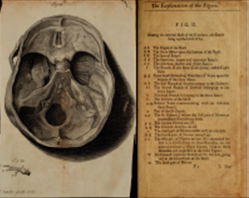
Title: The anatomy of the brain : containing its mechanism and physiology, together with some new discoveries and corrections of ancient and modern authors upon that subject : to which is annex’d a particular account of animal functions and muscular motion, the whole illustrated with elegant sculptures after the life.
Author: Humphrey Ridley
Published: 1695
‘The above text was the first book in the English language written on the human brain. Ridley’s studies using cadavers executed by hanging provided him with a novel view of the venous drainage and lymphatic system not seen as accurately by those before him. Since the study of the brain was still largely in its infancy, he was not without his errors of deduction as to the purpose of parts of the brain and its pathologies. With his dissections, however, Ridley was able to build on the collective knowledge of neuroanatomy and provided new insight into brain structure and function.’ (National Library of Medicine)
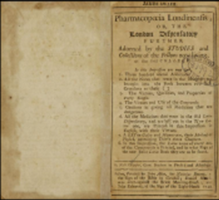 Title: Pharmacopoeia Londinensis, or, the London dispensatory.
Published by: Royal College of Physicians, London.
Translated from Latin by: Nicholas Culpepper.
‘The Pharmacopoeia enabled the Royal College of Physicians to create an officially sanctioned list of all known medical drugs, their effects and directions on their use. No one was allowed to concoct any medicine or sell any substance if it did not appear in the Pharmacopoeia Londinensis.
The authority of the Pharmacopoeia and of the College itself was dealt a blow in 1649 when Nicholas Culpeper published an English translation of the book, under the title The London dispensatory, which you can view above. Not only did Culpeper’s book render the Latin names of substances and methods of preparation into a language spoken by more of the population, Culpeper also included the descriptions of the uses of the different preparations, omitted from the physicians’ book.’ (Text taken from The Royal College of Physicians website).
There have been many editions of the Pharmocopoeia – we cannot be sure of the date of our copy, as the date was never listed in our catalogues.
 Title: Relationi vniversali di Giovanni Botero Benese, diuise in quattro parti. Arricchite di molte cose rare, e memorabili, con l’vltima mano dell’auttore.
Author: Giovanni Botero Benese
Published: 1600
Botero was a leading humanist from Piedmont who joined the Jesuit Order. As well as holding the notable distinction of being the first Malthusian (his work, On the Cause of the Greatness of Cities laid out a similar thesis to Malthus’s own, two centuries earlier), his Relationi universali is regarded as marking the beginning of demographic studies, and looks at the relations between countries.
 Title: The art of glass : wherein are shown the wayes to make and colour glass, pastes, enamels, lakes, and other curiosities.
Author: Antonio Neri
Published: 1662
‘As the Italian Renaissance entered its last century and Galileo Galilei was using his telescope to advance the science of astronomy, a Florentine priest named Antonio Neri was writing a guide for glassmakers that would inform their craft for the next 200 years. Titled L’Arte vetraria (The art of glass), Neri’s book was published by the Giunti printing house of Florence in 1612. It received only modest recognition in its first few decades, but it eventually gained sufficient attention to warrant a reprint in 1661 by the Florentine Marco Rabbuiati, as well as publication in Venice by Giacomo Biatti in 1663. In addition, Christopher Merret, an English physician, botanist, and librarian of the Royal College of Physicians, produced a translation in 1662 to which he added a substantive commentary.
One possible explanation for the popularity of L’Arte vetraria was that it disclosed Venetian glassmaking techniques, which had been carefully guarded secrets. The original Italian edition of L’Arte vetraria has the look and feel of a personal notebook, with recipes Neri developed from hands-on experience and experimentation in making glass. In the book’s preface, Neri expresses his love of glass, calling it a noble thing and a “fruit of the art of fire.”’ (Words taken from the Corning Museum of Glass’s website).
Four of these books originated from the Standfast Library – the former collection of the Reverend William Standfast. You can read more about the Standfast Library here: History of the Standfast Library