
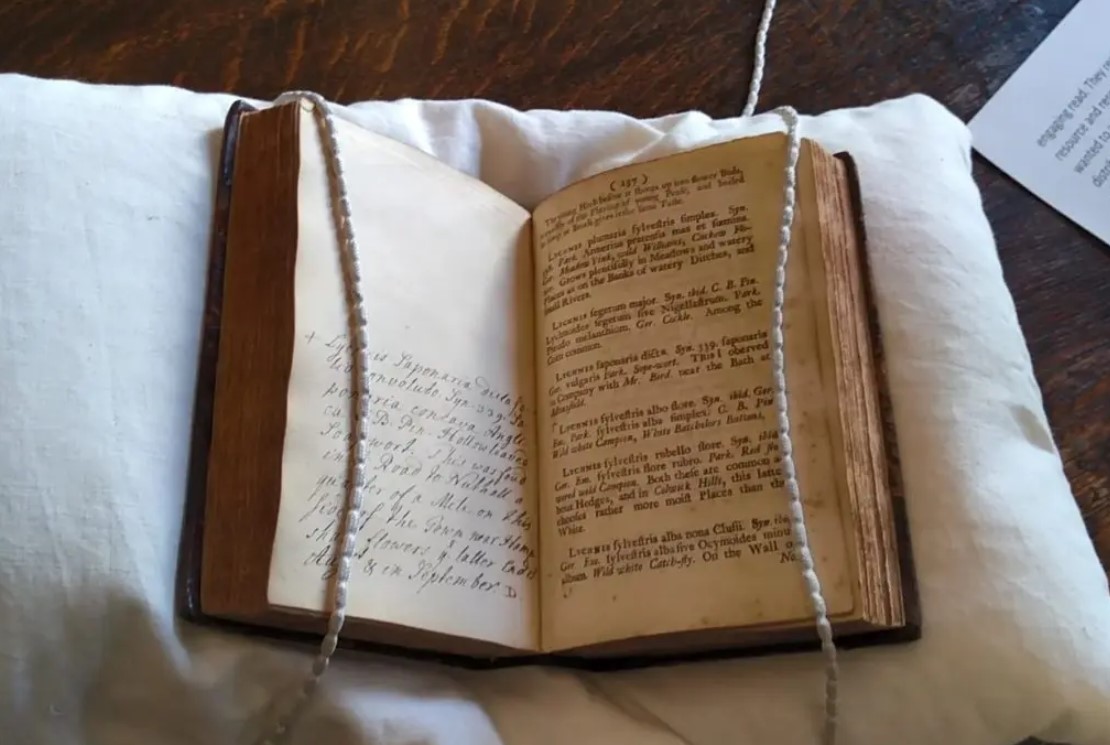
Can there be a more suitable as well as more agreeable interposition between the Bottle and Books, [than] the examination of the Vegetable world? Charles Deering, Introduction to ‘Catalogus Stirpium, or A Catalogue of Plants.’
We take a look at Charles Deering and his ‘Catalogue of Plants’
Charles Deering – originally Georg Karl Dering (c.1695–1749) – a German-born medical practitioner and, later, military officer – is perhaps best known at Bromley House Library for writing a history of Nottingham, but he also wrote the book quoted from above: A Catalogue of Plants: Naturally growing and commonly cultivated in divers parts of England, more especially about Nottingham. Deering was a highly intelligent man, who could speak at least seven languages and came to Nottingham with a recommendation from Hans Sloane. Despite this, Deering never achieved any great success as a doctor, and according to the Dictionary of National Biography “an unfortunate temperament seems to have interfered with his duties, and afterwards seriously reduced his former good fortune to something like poverty”. He died two years before the publication of his history of Nottingham (Nottingham Vetus et Nova), in the house he lived in opposite St Peter’s Church.
Charles Deering was working as a doctor when the Catalogue of Plants was published in 1738, and as such the book sits somewhere between what we might now call a wildflower guide, and a herbal.
Each plant found by Deering – and the guide also includes fungi, lichens, and mosses – is listed alphabetically by botanical name, along with where it was found, its flowering time, and any medicinal properties it may possess. His analyses are sometimes surprising – two highly poisonous plants, Deadly Nightshade and Hemlock, are found by Deering to have their effects muted by our cold British climate. Deering fed Deadly Nightshade berries boiled in milk “to dogs and cats without perceiving any ill effect”. Apparently, the renowned botanist John Ray had eaten half an ounce of Hemlock root without suffering ill consequence, and Deering, though not quite as bold as Ray, often used the plant outwardly as a poultice to reduce inflammations. Please don’t try any of this at home!
One thing you could emulate today is the people of Nottingham’s unusual use for Cleavers (Galium aparine – also known as Goosegrass and Sticky-weed). The people of Nottingham were known to rub their oaken tables with it, to make them look brown and glossy. Perhaps the hooks on Cleavers’ leaves, which make it so apt to stick to our clothing, helped to remove dust and grime, or perhaps the reddish dye present in Cleavers’ roots somehow helped to give the tabletop a darker colour. I’m not sure the library will let anyone loose with the Cleavers on their oaken tables, but if you’re of the adventurous sort, and have access to an oaken table, it might be worth a go at home.
There is at least one example of a colony of plants surviving from Deering’s day. The Alexanders (Smyrnium olusatrum) that grow at the foot of the Castle Rock as you go through the bollarded entrance to The Park Estate from Castle Boulevard seem to have been there in some form or other since 1738, though it once appears to have been more widespread. I also hold the fanciful notion that the particularly beautiful, purple-flowered Comfrey that grows along the canal between West Bridgford and Cotgrave might be some relation of the purple-flowered Comfrey Deering found growing on the bank of a watery ditch just beyond Trent Bridge, going to Wilford. Perhaps that one’s a bit of a long shot.
Conversely, there are plants in the Catalogue which were becoming rare as Deering was recording them. The non-native Blessed Thistle, which coincidentally has one of the best sounding botanical names of any plant (Cnicus benedictus) was used as a plague cure in medieval times. It was recommended to Beatrice in Much ado about Nothing as a cure for a racing heart (though suggesting that Beatrice might be cured with the aid of a tincture of benedictus is obviously, deliberately, tongue-in-cheek). By 1738 the plant was rarely found outside of gardens growing it for use as a pharmaceutical, and though it “may serve for a gentle vomit” it was no longer regarded as a miracle cure.
While the Blessed Thistle was falling out of use, White Horehound, (Marrubium vulgare) – a perennial closely related to dead-nettles – was proving itself far too useful. The plant was very common in Nottingham City until a “certain physician, extolling its virtues to the skies and recommending it in almost every case especially to persons who had impaired their constitution by hard drinking, has set all the Ale Bibbers to work to root it out, insomuch as it has become very scarce”. The plant is now not only rare in Nottinghamshire, but nationally, though it is still used in herbal medicine, largely to aid in the treatment of bronchitis and as an ingredient in cough candy.
In Deering’s introduction to the Catalogue he makes a connection between mental wellbeing, and engaging with what he would call the “vegetable world”, which, behind the language is strikingly modern. “As to the mind”, Deering writes, “it will always be employed about something or other, and the viewing and examining the gay produce of the Earth with effectively unbend and divert it from more crabbed contemplations; the new acquaintance with her children will prove a most pleasing entertainment, and the more it is cultivated the more valuable it will appear”.
We have three copies of Deering’s Catalogue of Plants in the library, one being Deering’s own, interleaved copy with corrections in his own hand. None of these books are loanable, but you are of course welcome to have a look at a copy in the library.