

Howard Spring was the author of popular novels written between 1932 and 1964, many of which had a Manchester background, and featured working class life, work and culture, as well as the higher society and bohemian circles whose paths were crossed by his characters.

Associated Press photograph of Howard Spring c.1946, which accompanied his obituary in 1965
The books had powerful plots, with rags to riches stories, which told of the struggles of his characters to rise above the circumstances of their early lives, and to face calamities head-on, sometimes with tragic consequences. Conflict between the generations is often an undercurrent running through the narratives. These vivid storylines, with their occasional lapses into melodrama, revealed both flashes of revelation, and shadows of pathos.
The compelling plots, combined with a colourful supporting cast of strong and memorable men, women and children, proved irresistible to public and reviewers alike. Contemporary critics compared him with Dickens, although, as he points out in his autobiography, Howard was compared with many writers:
“My work was compared with the work of the most improbable collection of “influences”. Among others to whom I owed my style and attitude to life, or both were Dickens (the most frequent) Thackeray, Arnold Bennett, William Faulkner, A.P. Herbert, Rabelais, Marie Corelli, Jeffrey Farnol and Somerset Maugham”
Howard Spring was born in Cardiff, in 1889, one of nine children. His father was a jobbing gardener and his mother a charwoman, who took in laundry. At the age of twelve he went to work as an errand boy for a butcher, but he hated the smell of the meat so much that he soon left and found a job as office boy for the Plymouth Brethren. After a year of clerical work and typing, he was ready to move on. His sister worked as a servant for one of the sub-editors of a Cardiff newspaper, and she learned that the paper needed a messenger boy. Howard got the job.
In his autobiography, Howard describes how “blind chance” had taken him to a newspaper office. He was happy there at once, and was happy in newspaper offices ever since. He describes his work vividly:
“There was all sorts of work. There was running down to the station for parcels of news sent in by the district correspondents, there was opening the unending streams of telegrams, and learning to sort them into home news, sporting news, foreign news, and to deliver them to the sub-editor concerned. There was running down to the machine-room for editions. A grand place the machine-room, worked by steam in those days”
This description is a fine example of Howard’s style of writing his novels – lively, engaging, full of action and expression.
Howard tells of a suitcase of books, left at his family’s house by a lodger at around this time, which he called “the great awakening”. He and one of his brothers read their way through Darwin’s Origin of Species, Drummond’s Natural Law in the Spiritual World, Goethe, Hawthorne; Thackeray, and a “hotch-potch of other stuff, all good of its sort”
The next stage of his self-education came when Howard enrolled on a series of evening classes. For the next five years, he studied English; French; Latin; maths and history, and eventually became a reporter for the South Wales Daily News.
In 1915, he went to work for the Manchester Guardian, and returned there after service in WWI.
Another lucky chance in his career happened in 1931, when he reported on a speech given at a political meeting in Manchester by Lord Beaverbrook. He described the newspaper publisher as “a pedlar of dreams.” Beaverbrook was so impressed by the turn of phrase that he offered Howard the job of book reviewer for the Evening Standard in London.
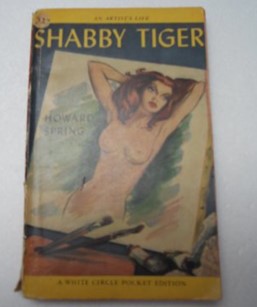
Howard’s first book was a children’s story, Darkie and Co, published in 1932, and his first adult novel was Shabby Tiger, (1934). This is the story of free-spirited Irish girl, Anna Fitzgerald, a servant who leaves her life of drudgery, and falls in love with a struggling artist Nick Faunt, who is in fact the son of a millionaire. The book has a very strong sense of location, with its descriptions of the streets of Manchester, and has all of the characteristics which became recognisable as the Howard Spring style – humour, compassion, tragedy and resilience. It was filmed as a TV series in 1973, starring Prunella Gee as Anna.

In Hard Facts (1944) and its sequel, Dunkerleys (1946), Howard’s newspaper experience provides a background for the stories of a printer, Dan Dunkerley, who sets up a cheap and hugely successful newssheet, full of “facts” such as: “ every hour so many gallons of water pour over Niagara Falls, the cab horses of Manchester eat every week a quantity of hay equivalent to the crop of so many acres, if all the hair cut by Birmingham barbers were stuffed into mattresses, beds could be provided for so many people”. Dunkerley makes a fortune, and goes on to build an empire of publishing trashy and increasingly informative papers and magazines. He is surrounded by family and workmates whose joys and tragedies are at the heart of the books. Among these are brother and sister, Alec and Elsie Dillworth, whose poignant story tells how they emerge, damaged, from a childhood of vicious brutality, grinding poverty, drunkenness and enforced prostitution. Their struggles through the awakenings of their adult life are painful and heartrending to read, as all their glimpses of happiness, love and redemption seem doomed.
Fame is the Spur (1940) tells the story of a politician, believed to be based on Ramsey MacDonald, who rises through the emerging Labour Party. It is set against a background of Ancoats slums, Welsh coalfields, the Peterloo Massacre and the women’s suffrage movement, moving on to Parliament and the House of Lords Wide reaching, and ambitious in scale, it was made into a film starring Michael Redgrave in 1947, and a TV series starring Tim Piggott-Smith in 1983.
The TV series of Shabby Tiger is fondly remembered to this day, not least for the full frontal nudity (the first in a British TV series) revealed in Prunella Gee’s appearance as artist model Anna. A Lancashire artist named Malcolm Young played the “part” of artist Nick Faunt’s hands, and he did the actual sketching and painting used in the series.
Most of Howard Spring’s books are available in paperback today, and here at Bromley House we have 11 of his titles, plus his autobiography.
Below is an image of the striking 1948 Canadian edition of Shabby Tiger, sadly not the copy we have in the library!
Above, I’ve also added an photo of Howard Spring, who has more than a passing resemblance to the current Conservative MP for North East Somerset, famous for going canvassing accompanied by his nanny….
Sally