
Following a very successful and popular talk held at Bromley House in 2023 by Nottingham Women’s History Group (NWHG), Karen Winyard has delved into the archives and carried out more research into Mary Bailey, her life and work which she presented in September 2024 and has kindly provided a very informative research article.
Her ‘Poor Imperfect Muse’
This was how Mary Bailey described her poetry in Address to the Ladies, one of thirteen poems she published in 1826 in a collection titled Poems Humourous and Sentimental. Mary is similarly self-deprecating in her introductory note, To the Reader.
The writer of the following Verses does not presume to
send them to the world as perfect Poetry: she is conscious
that they are very deficient; but, as some Ladies have been
pleased to express a favourable opinion of them, she has
been encouraged to commit them to the press, hoping
that, what is not correct, will meet with an excuse from
the candid reader.
The poems that follow are, however, very far from imperfect. They reveal a young woman who is intelligent, witty, mischievous, loving and enterprising. Mary writes from the heart and with a clear purpose. Her poems, which are autobiographical, powerfully express her personal feelings. Her voice rings out from the page creating the sense that Mary speaks directly and intimately to each reader, whether she is writing about happier family times or expressing her desperation and despair as she struggles against poverty.
Mary (1795 – 1828) was not born into poverty. She was the daughter of Francis Thornewill, a prosperous manufacturer of iron goods from Staffordshire. Like many middle-class girls of the period, she received an education. When in her teens, Mary took up a position as ladies’ maid with a high-ranking family, probably in Leicester; where, when she was eighteen Mary married William Bayley, a tailor from Hints in Staffordshire. Possibly Mary’s father disapproved of the match as Mary did not return to her home parish for her wedding. Mary should have had her father’s consent to the marriage as she was a minor, but this is not recorded in the parish register. William and Mary began married life in Leicester, moving to Nottingham around 1824 where their sixth child, Ellen, was born. Two years later, Mary gave birth to twins, James and Jessy; and in 1828 to her ninth and last child, Emma.
The poems selected for publication were written between 1824 and 1826; Mary hoped sales would supplement the family’s income. The first edition was published by Christopher Norton Wright apparently without a subscription scheme. Wright was a native of Fazeley in Staffordshire, only three miles distance from William Bayley’s home village, Hints. It is possible he printed the booklet as a favour to the family. Mary’s situation may have further attracted his attention and sympathy by reminding him of his mother. In his memoir, No Hero I Confess, Wright recalls how his mother lived in poverty after secretly marrying a man without means, causing a rift with her father. Seemingly, Wright’s edition was unsuccessful as a second was published by Samuel Bennett later the same year, this time by subscription. When Mary died two years later the family were still impoverished, which suggests the book did not sell well enough to substantially assist them.
There are indications in several of the poems that the Bayley family were not completely impoverished when they first arrived in Nottingham. Lines written to a Gentleman who asked the author to write some Verses on a young Lady, but who afterwards altered his mind provides a picture of Mary and William running a tailor’s workshop and sharing their love of poetry with others in their community:
One day a poor woman I saw,
As musing she walk’d on the road,
And into our shop she just happen’d to pop,
And a copy of verses she show’d.
I smiled, for you know I admire the art,
And some little attention I paid;
And both father and I condescended to read
The verses this rhymer had made.
Mean elf as I was, for I can’t but reflect;
Why what in the world should I do,
But, forgetting to pay you a proper respect,
I ask’d her to write upon you.
Mary continues to explain to her friend that, in the end, she also changed her mind. The verses would have fallen short of the quality of poets such as Homer, Virgil, Milton, Byron or Kirke White and, therefore, been unacceptable.
Address to the Ladies is interesting because it was clearly written to advertise Mary’s trade in second hand clothes and to drum up business; a trade that would have been a good fit with her husband’s work as a tailor. It is impossible to tell whether it was written as a separate piece of advertising or whether Mary produced it specifically for publication in her booklet. The last verse echoes the note To the Reader,
And, to those ladies who’ve encouraged me,
My heartfelt thanks, sincerely, I return;
Hoping their favours will continued be,
And with warm gratitude my heart shall burn.
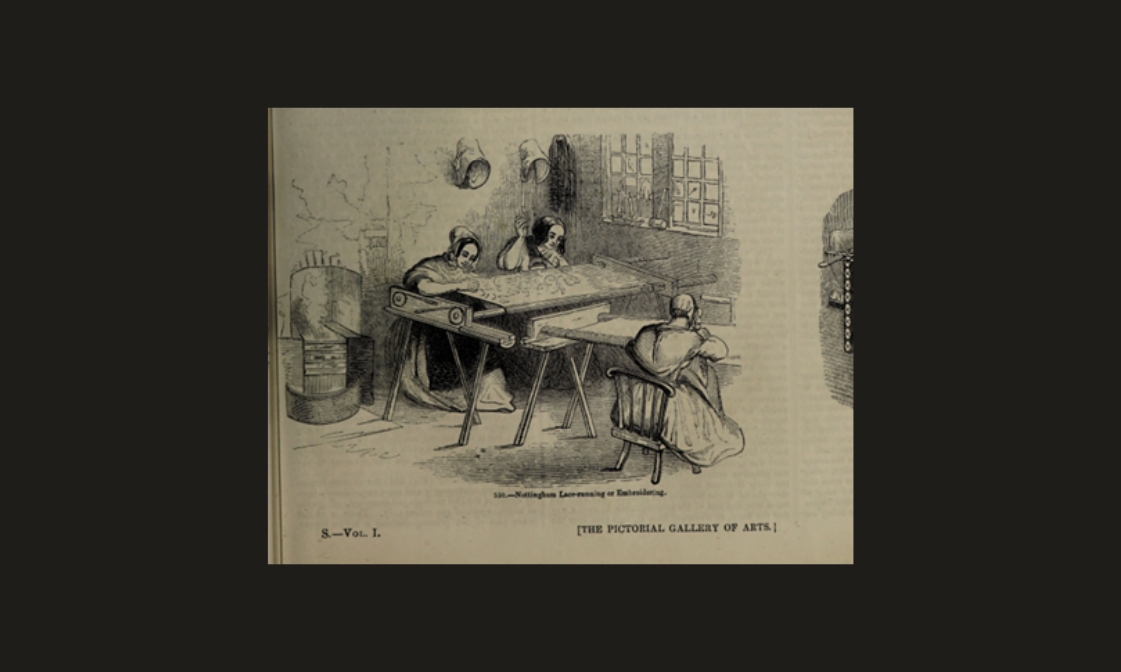
Mary understood the value of her skill as a poet in attracting the support and patronage of the wealthy women of Nottingham. Petition to the British Fair is written in a similar vein, and is the only poem that specifically references lace runners. It is surprisingly impersonal in tone, appealing to wealthy British women on behalf of Nottingham’s lace runners as a whole. Again, we are left wondering whether this poem was written for the booklet, and if not, what prompted Mary to write it, what she hoped to gain from it and how she intended to place it before an audience.
Nottingham lace runners, from The Pictorial Gallery of Arts, Vol 1, Charles Knight. Source: Wellcome Collection, Public Domain Mark.
https://wellcomecollection.org/works/xuhnrn7u/items
During the four years that we know she lived in Nottingham, Mary and her family frequently moved within the lace market area. They lived on Woolpack Lane when their daughter Ellen was baptised, but subsequently moved to Mill Street, Kingston Place and, finally, New Charles Street.
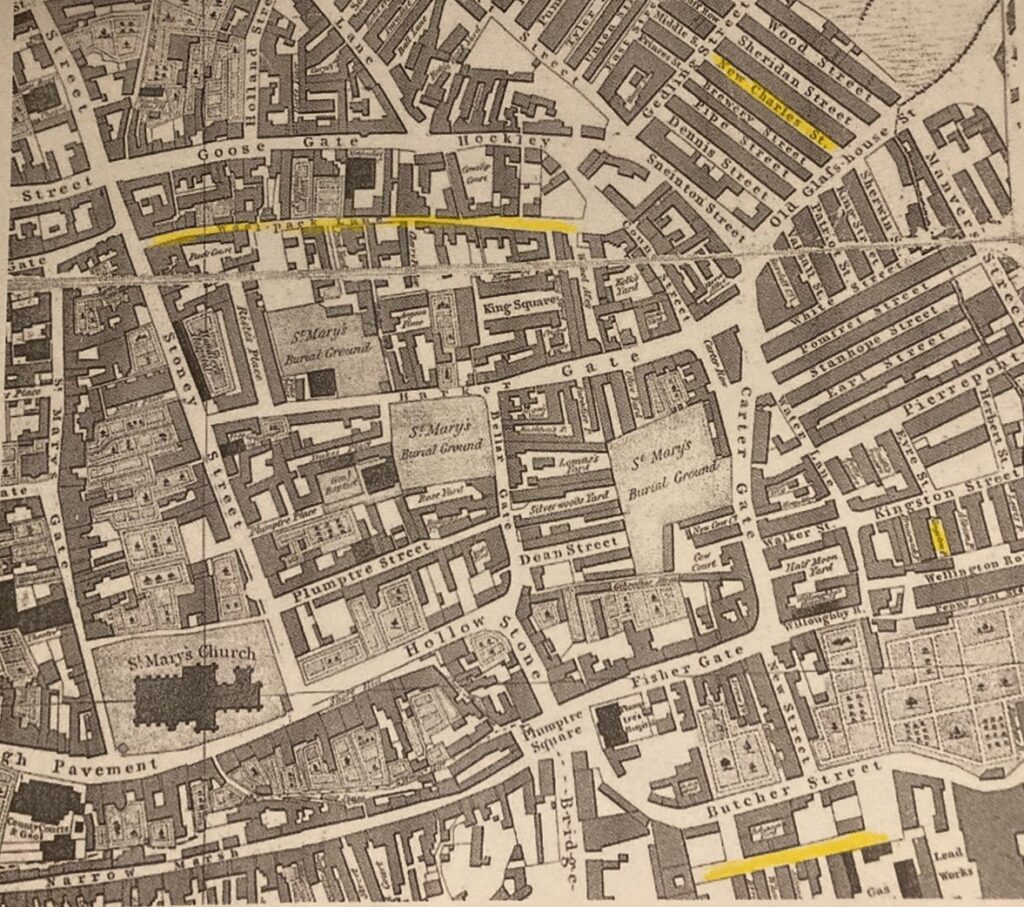
Enlarged section of Staveley and Wood’s map 1831 showing the streets where the Bayley family lived. Mill Street is unnamed, but sits below Butcher Street.
This was largely back-to-back housing; cramped and badly ventilated, a breeding ground for disease. If Mary worked as a lace runner, she would have worked from home, in these conditions, at the same time raising her young family. Four poems vividly convey the hardship and despair Mary experienced.
The day and evening hard I work’d,
In sickness, and in pain,
In hopes, for my dear little babes,
Some fire and bread to gain.
The clock went eight —my work was done,
Away, in haste I fled;
Nor had I then the slightest doubt,
But soon to obtain some bread:
But disappointment mocked my hopes, —
Back, pennyless, I came:
‘Tis only you, can sympathize,
Who’ve known and felt the same.
With upraise’d eyes to Heaven, I cried—
O God! how hard’s my lot;
Nor was a prison dreaded more
Than entering my cot.
(Extract from To a Lady who visited the author when she was in great distress.)
On this occasion Mary was helped by one of her benefactors who brought her food and fuel for her fire. Other women took a more moralistic tone, as evidenced by the companion poem, To a Lady who desired me to pray for the death of my youngest child, advice Mary vigorously rejected. But in Ode to Hope and The Author to her Infant Twins Mary describes how, ‘drear misfortune crowds each prospect here’ and ‘keen affliction scarce a day omits’ without visiting her home. The grasp of poverty’s iron hand spoils Mary’s joy in her babies, chilling every warming kiss she gives them. And yet, Mary retains her faith in a benevolent God to the end, trusting that He will ‘loose us from the grasp of poverty’ and ‘strew this thorny path with flowers’.
Tragically Mary died six weeks after the birth of her daughter Emma. She was thirty-three years old. She did not experience the longed-for salvation from poverty, but it is a kind of miracle that thirteen of her poems survived and that she can speak to us today.
Karen Winyard
Links:
Nottingham Women’s History Group offers a talk, From Riches to Rags. The Life of Mary Bailey, Poet and Runner of Nottingham Lace. For more details contact nottmwomenshistory@gmail.com or visit www.nottinghamwomenshistory.org.uk.
You can borrow a copy of Five Leaves edition of Mary Bailey’s poems, Poems of a Nottingham Lace-Runner, from Bromley House Library, shelfmark Db2809, Neville Hoskins Reading Room. Copies are also available to buy from Five Leaves and Bromley House Library for £4
Christopher Norton Wright’s memoir, No Hero I Confess, is available on the internet archive,