
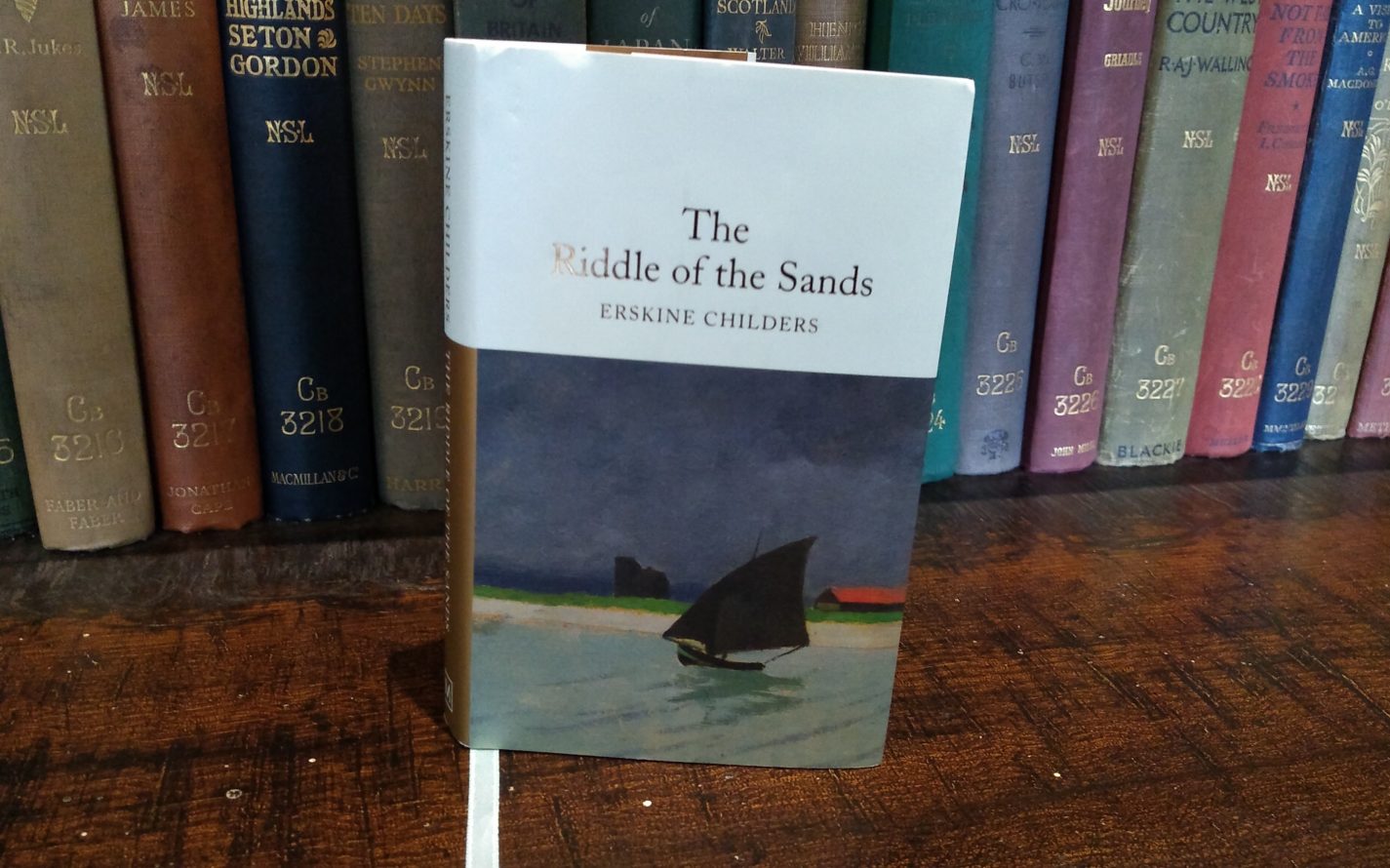
In June our Classic Crime Bookclub took a bit of a deviation from our usual 1920s-’30s murder mystery and read ‘The Riddle of the Sands’ by Erskine Childers from 1903. Not only was this written earlier than our usual reads, but it’s also a step away from detective fiction, being an early example of a spy thriller. The book has been described as a ‘boys own adventure’, and there is certainly an element of that in the tale, but in many ways it defied our expectations, being also funny and exciting and very atmospheric, as its fallible heroes attempt to discover military secrets in the sands of North Frisia. In addition to our appreciation of the book, we had the opportunity to learn more about the author. Bookclub member Sue Atkinson went above and beyond in researching Erskine Childers, and discovered a fascinating, and ultimately tragic life:
Robert Erskine Childers (1870-1922)
It’s fair to say that Classic Crime Club members were as fascinated by the author of ‘The Riddle of the Sands’ as they were by his fine espionage novel. Here we can only scratch the surface of Childers’ complexities, and the salient points of his life which led to its tragic end: Born in 1870, he was effectively orphaned at the age of six, along with his four siblings. Their father, Professor Robert Caesar Childers, a scholar of Hebrew and a pioneer of Western linguistic studies of Buddhism, died at 38 from a virulent form of TB, going to a hotel to die to spare his family, when he knew his death was imminent. The children’s mother, Anna (nee Barton) had kept her husband’s illness a secret in order to keep the family together. Castigated for this irresponsibility, she was removed to a home for incurables, where she herself died of TB six years later. She was from an Anglo-Irish landowning family and the children were sent to her relatives at Glendalough, where Childers spent the next four years, before going to Haileybury School and thence to Trinity College Cambridge to study Classics, which he soon jettisoned for Law. He entered the House of Commons as a clerk, a reserved man and excellent at his job, before volunteering for the Boer War despite a sciatic injury which plagued him all his life. So far, so patriotic, largely conformist, and imperialistic – as was the creed of the times.

Robert Erskine Childers, right before heading to the Boer War in South Africa, 1899 (source: Wikimedia Commons)
He published ‘The Riddle of the Sands’ in 1903, describing it as “a novel with a purpose” – to show the limitations of national preparedness for a European War and the replacement of England’s traditional enemy, France, by an even more ambitious Germany. Soon after this, Childers visited Boston, in the USA, with his battalion, which proved to be a hugely significant event in his life. There were many of Irish descent in Boston who were sympathetic to the Irish nationalist cause, and it was there he met his future wife Molly Osgood, later seen by some as the power behind Childers’ own powerful influence on de Valera’s Irish revolutionary party. The couple were married in 1904.
Childers’ interest in Ireland continued to grow, and he became committed to Home Rule, though it was some years before this was foregrounded in his life, as he continued to work first as Churchill’s private secretary, plus raising his family, and investigating the German question. He then gave up his secure career, and between 1912 and 1914 he served as the Liberal candidate for Plymouth, and sailed the Baltic with his family. At this time he also became involved with a committee running guns from Hamburg to Ireland for the Irish Volunteers, using his boat The Asgard to transport them, with his wife Molly and other volunteers on board.
Further involvement in the Irish struggle was put on hold with the outbreak of the First World War, in which Childers served on the aircraft carrier HMS Engadine, while Molly worked with some of the thousands of Belgian refugees who had arrived in the country. On his return, Childers heard the tragic news of the harshly-suppressed Republican rising in Dublin in 1916, which shocked and horrified him. After nearly dying in the flu epidemic of 1918, and recuperating at Glendalough, he became fully involved in the struggle for Irish Home Rule. At first this took the form of him lobbying on the Irish question, and travelling to the Paris Peace Conference in an abortive attempt to publicise the Sinn Fein case for Home Rule legislation. Back in Ireland, he attempted to reach Dublin at the behest of de Valera, who was attempting to set up an underground government there. He was apprehended by troops at Glendalough, arrested in possession of a firearm, and sentenced to execution. On hearing of Childers’ arrest, Churchill denounced his character in the harshest of terms. On 24 November 1922, as he went to meet his death, Childers shook the hand of every man in the firing squad, saying ‘Take a step or two forwards, lads. It will be easier that way’.

Robert Erskine Childers, c. 1920 (source: Wikimedia Commons)
Fast forward to July 1961 when de Valera, old and almost blind, stood beside one of his cabinet ministers, Childers’ eldest son, who would succeed him as President in 1973. Together they welcomed The Asgard back to Irish shores, where she would serve as a training ship for the State. De Valera spoke of her as a “harbinger of liberty”, and with her return Childers’ role was publicly acknowledged by his friend, and his place in history assured.
Source: “Erskine Childers” by Jim Ring (1966) published by John Murray Ltd
Sue Atkinson