

“They are the patient sorrows that touch nearest”
Last year our copy of the book ‘Eastern Hospitals and English Nurses’ by A Lady Volunteer (3rd edition, 1857) [Dd 1866] was rebound with the generous support of library member David S. Stewart. The book sheds fascinating light on the personal experiences of the nurses who went out from England to help the sick and wounded during the Crimean War. David has written an article about the book for the Nottinghamshire Nursing History website, and has kindly given us permission to share it here as well:

In 2020 the bi-centenary of the birth of Florence Nightingale led me to relook at the history of the Crimean War and in browsing in Bromley House Library I came across a book, ‘Eastern Hospitals and English Nurses’ by “A Lady Volunteer”. The sub title was ‘The Narrative of Twelve Months Experience in the Hospitals of Koulali and Scutari’. Against the word ‘Volunteer’ someone, presumably a helpful librarian of yore, had written in pencil “Taylor, FM”. The book was in a parlous state, in desperate need of repair. I arranged for the rebinding and I am pleased to say it is full restored for others to enjoy.
So who was ‘Taylor, F M’? This was Frances (Fanny) Margaret Taylor (1832-1900) the youngest of ten children of Rev Henry Taylor, Rector of Stoke Rochford in Lincolnshire. On her father’s death, the family moved to London. Keen to work with the poor and vulnerable she stayed with the Devonport Sisters of Mercy, where two of her sisters had joined this Anglican sisterhood led by Lydia Sellon. Working in Bristol and Plymouth she developed her nurse training and hospital work.
With the outbreak of the Crimean War, Fanny was keen to join the volunteer nurses. She was chosen for the second cohort of lady volunteers and paid nurses who accompanied Mary Stanley in December 1854. The book recounts her experiences in the following year and her views on nursing, based on this experience.
The edition in Bromley House is a cheaper edition, aimed at a wide audience. The first edition had been published by Hurst and Blackett in March 1856 in two volumes, costing 21s. It had run to a second edition in August but the publishers clearly felt there was also a demand for a cheap edition, costing 6s, which was published in January 1857. The book had received favourable reviews when first published: On April 17th 1856 The Sun acknowledged that the author was one of the earliest bands of nurses who worked in the hospitals “through those terrible months when confusion and mismanagement reigned pre-eminent.” The publishers were keen to associate the book with the noble deeds of Miss Nightingale but in truth Fanny Taylor’s sentiments are far more for Mary Stanley who had led the second group of nurses, and indeed had found Florence Nightingale to be less than responsive to her presence in the Crimea.
Mary Stanley (1813-1879), daughter of the Bishop of Norwich, had written ‘Hospitals and Sisterhoods’ in 1854, outlining issues of the training of nurses. She helped with the recruitment of the first group of nurses to go out to Constantinople, which included nuns of the Sisters of Mercy. She had been friendly with Florence Nightingale but a rift quickly emerged when she went out to the Crimea. Mary converted to Roman Catholicism, as did Fanny Taylor, probably another source of tension with Nightingale. (Mary’s brother, Arthur, was the Dean of Westminster and her cousin’s wife was the formidable Lady Stanley, founder of Girton College, Cambridge.)
Fanny Taylor describes the excitement at Mary Stanley’s house when their uniforms arrived, when “the long ones fell to the share of the short people and vice versa”. The “Costume” consisted “of a loose wrapping gown of dare grey tweed, a worsted jacket, plain linen collar and thick white cap; passing over the right shoulder was a broad strip of brown Holland, embroidered in red worsted with the words “Scutari Hospital.” A short grey worsted cloak, brown straw bonnet, and veil, completed the dress.” This seeming equality of costume between the lady volunteers and the paid nurses was quickly dispensed with in Therapia!
It was ironic that the words “Scutari Hospital” were embroidered, for when the party arrived it was made very clear that Florence Nightingale did not want them at Scutari, the party spending several weeks in Therapia with little to do, much to everyone’s frustration.
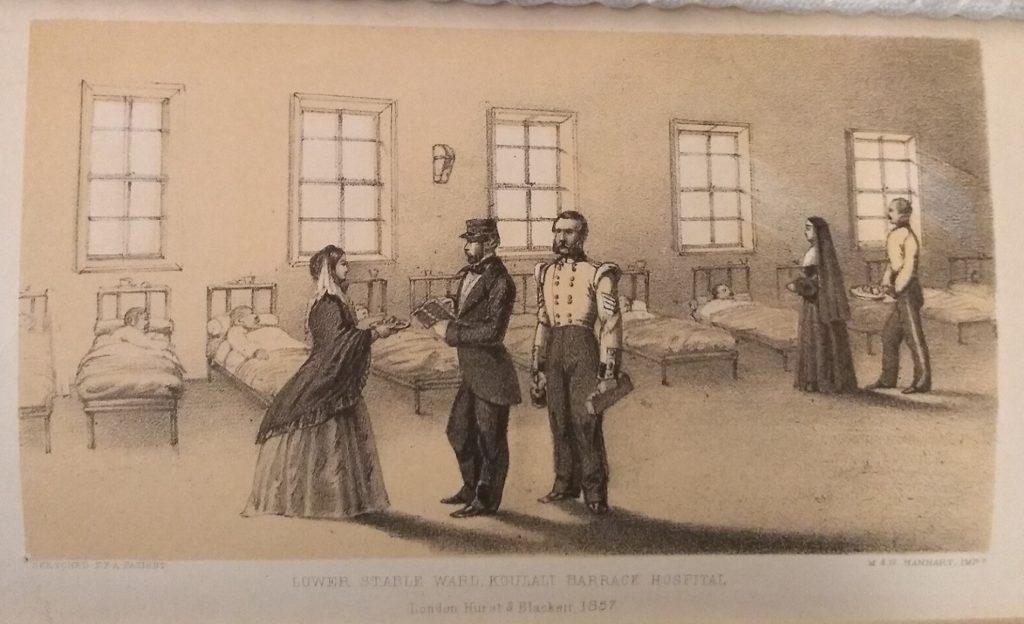
The reviewer in The Sun had noted, “the writer constantly alludes to the difficulties occasioned by the misconduct of the hired nurses, half of their number having to be sent home in disgrace.” Fanny repeatedly refers for the need of volunteer ladies or Sisters of Mercy to supervise the hired nurses. Anyone reading the book will be struck by the English class system being played out. There had been problems from the start. “The ladies had suffered from it during the journey; for having no authority to restrain the hired nurses, they were compelled to listen to the worst language, to be treated not unfrequently [sic] with coarse insolence.”
By contrast, Fanny spoke favourably about the discipline of the sisters from the holy orders. She was very impressed by the Sisters of Charity who were held in such high regard by the French soldiers. In Koulali the Irish soldiers were comforted by being ministered to by the Catholic sisters.
The frustration at being idle in Therapia was great when they knew of the work which needed to be done in Scutari, where in January 1855 there had been nearly 1500 deaths. Finally a few were allowed to go to Scutari, including Fanny, whilst Mary Stanley and others of the party went to the hospital in Koulali. Fanny was shown round by Miss Nightingale and given the charge, with another lady and one nurse, of 1000 patients. “When we woke in the morning, our hearts sank down at the thought of the woe we must witness during the day.” Fanny stayed only a fortnight, taking the opportunity to join her mentor Mary Stanley at Koulali. Here the patients were not the wounded but those with fever, dysentery, diarrhoea and frostbite.
In much of the book comes Fanny’s frustration about what the ladies and nurses were not allowed to do by the military doctors, often feeling they were underused. She describes much about the world she encountered, including shopping in Constantinople and meeting the wives of the harem.
Fanny’s experience with the hired nurses led her to question how a proper nursing system might be established in British hospitals. She was concerned that a plan of employing hired nurses only, “is not the one that will meet the much-felt want. There must be a higher principle at work than that of gain or applause.” In her introduction to the 3rd Edition, she made a plea that if hired nurses were to be employed they should be under the direction “of those who, from higher motives, have devoted themselves, for a time at least, to the work in question.” Of course there were well-motivated nurses too, and Fanny was quick to name them. Perhaps she realised that her damning of the nurses had led to difficulties for some to find work on their return to England. She admits that many were refused employment because they had been engaged in military hospitals. “Private families hesitated to employ nurses they imagined must be demoralized by living in military hospitals.”
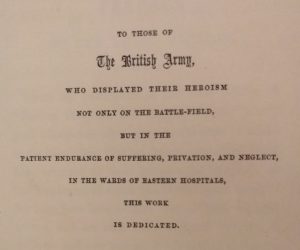
In her concluding remarks Fanny makes it clear what she thought about the authorities and indeed suggests that Nightingale’s rigidity about numbers was also unhelpful. Mary Stanley had to use her influence back in England to gain more nurses for Koulali. Fanny felt frustration again when later in the year, when there was greater need for nursing in Crimea itself, this was refused.
“The life in the East was eminently calculated to bring out the whole bent of a person’s character, for it was destitute of the help and restraint which the ordinary rules of English society afford.”
After the Crimea, Fanny became editor of ‘The Lamp’, a penny magazine for Catholics. She later became a nun, Sister Mary Magdalen, founding an order, The Congregation of the Poor Servants of the Mother of God. At her death in 1900, the order had 20 convents. In 2014 she was declared Venerable by Pope Francis.
With thanks to Anja Thompson-Rohde for taking the pictures.
David S Stewart OBE D.Litt.h.c. DL