

‘She must write her novel while she could. Thank heaven she had a new exercise book from Woolworth’s.’
Over the past couple of years, I have been working on a biography of British interwar novelist, Dorothy Whipple. What has become clear to me as I have studied the archival evidence that survives from Whipple’s life, is that her wish to become a writer was with her from very early on. From the age of three she was entertaining her siblings (she was one of eight) with stories from her imagination. She began publishing at the age of twelve, in the local newspaper, The Blackburn Weekly Telegraph, in the ‘Children’s Corner’. She continued to publish increasingly sophisticated stories there, that often addressed issues of class and social snobbery, up into her late teens.
Dorothy Whipple was born in Blackburn in 1893, but it was not until 1927, at the age of 34, that she published her first novel, Young Anne, with Jonathan Cape. In addition to eight novels, Whipple would produce many short stories, two memoirs and children’s books. Her work was immensely popular from the publication of her second novel, High Wages, in 1930 with John Murray after the book had been rejected by Jonathan Cape. Whipple’s subsequent five novels were critically acclaimed and commercially successful. Two of the books, They Knew Mr Knight and They Were Sisters were made into feature films. Her last novel, Someone at a Distance, was her (unintentional) swansong. Although the book is a favourite with Whipple’s contemporary readers, it was largely ignored by reviewers when it appeared in 1953, four years after her previous novel, Because of the Lockwoods. Whipple’s current success is due to the republication of all of her novels, both memoirs and collections of short stories, by Persephone Books.
Most of Dorothy Whipple’s novels were written in Nottingham where she lived at 35 Ebers Road with her husband, A. H. (Henry) Whipple. The couple had moved to Nottingham from Blackburn following Henry Whipple’s appointment as Nottingham’s first Director of Education in 1924. The efforts of Bromley House Library member Helen Lewis, with the support of the Library and the Nottingham Women’s History Group, resulted in a crowdfunded blue plaque for 35 Ebers Road commemorating Whipple’s writing life there.

Dorothy Whipple (née Stirrup) by Elliott & Fry
Copyright: National Portrait Gallery, London
Many of Whipple’s novels feature a literary female character with an ambition to write. These characters sit slightly outside of social interactions; they observe their families and friends, colleagues and household help. Dialect and dress are recorded. Whipple’s personal archive is held at the Blackburn Central Library. Many of her notebooks (most bought from Woolworth’s) survive. In addition to autograph manuscripts of many of the novels, the notebooks brim with her observations of her local environment; dialects heard on the bus, conversations heard at the shops and at parties.
Dorothy Whipple’s fourth novel, They Knew Mr Knight, published by John Murray in 1934, charts the rise and fall of the middle-class Blake family. Corruption, temptation, pride and ambition fold together to undo the seemingly straightforward Blakes. The youngest of the three Blake children, Ruth, has literary ambitions. When the family’s lives implode with the arrest of the father, Tom Blake, for fraud, Ruth decides that in addition to taking a secretarial job, she will begin the book she has planned to write. Ruth makes a start:
She sped upstairs to her room and locked the door. The bed was made and all was tidy. She pulled the table up to the window and got out the notebooks she had filled in France…She must write her novel while she could. Thank heaven she had a new notebook from Woolworth’s. She always felt that to begin anything she must have a new book. She sat down, unscrewed her fountain pen and waited. She gazed out into the garden, but her eyes gradually became blind to what they stared at. She was looking inwards. She saw people going up and down the stairs in an imaginary house, she heard their voices, noted the turn of their heads. She followed them into rooms; she listened. Her eyes took on a further blankness. She bent over the exercise book and began to write.
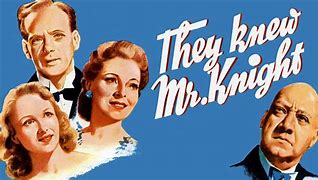
Film poster from the 1946 release of They Knew Mr Knight, based on Dorothy Whipple’s novel published in 1934
Even if Dorothy Whipple did share this character’s immersion in the creative process of writing, there were obstacles to her achieving her goal of literary success. Unlike many of her contemporary female authors, Whipple did not have the advantage of a university education where she could have deepened her understanding of English literature, and made valuable social contacts in the literary world. For example, her exact contemporaries, with whom she would later correspond, Vera Britain and Winifred Holtby, met at Oxford after the First War. Whipple seems to have missed this opportunity in spite of coming first nationally in the examinations in English Literature and Language when she left school (citation for this?). Although there is no written evidence, it seems probable that she was forbidden to take up a place at Oxford by her father. Whipple was also from the industrial North and even though her parents clearly had social ambitions for her (the Blackburn Weekly Telegraph records Dorothy Whipple’s appearance at a string of Charity Balls just before the First World War), her social sphere did not bring her into contact with her contemporaries in the home counties and London. Ironically, Dorothy Whipple’s literary fortunes were deeply influenced by a man who epitomised many of the class distinctions that had previously closed doors to Whipple’s literary development, Ronald Barnes, the Third Lord Gorrell. Gorrell was a partner in the publishing firm of John Murray from 1928 to 1951. It was Gorrell who rescued Whipple’s second novel, High Wages, after it had been rejected by two John Murray readers, and it was Gorrell, not J.B. Priestley, who first suggested that Whipple’s style and domestic focus as well as her humour put her ‘of the tribe’ of an early John Murray author, Jane Austen.
Dr Cynthia Johnston
Institute of English Studies, School of Advanced Study
University of London
Cynthia’s lecture on Saturday 5th of April is full – but please contact Matt here if you would like to go on a list for cancellations. We are showing the film They Knew Mr Knight on Saturday 26th of April at 11am and you can book a ticket here
We will also be holding a small exhibition about Dorothy Whipple in April 2025 with items reproduced from the Dorothy Whipple archive. With many thanks from the team who care for the archive for working with us on this project. Elements of this exhibition will be digitised and made available online.
We are working closely with Blackburn Central Library and the Community History Team who look after the archive. You can visit their Community History website here
For past articles on Dorothy Whipple published by Bromley House Library visit here