
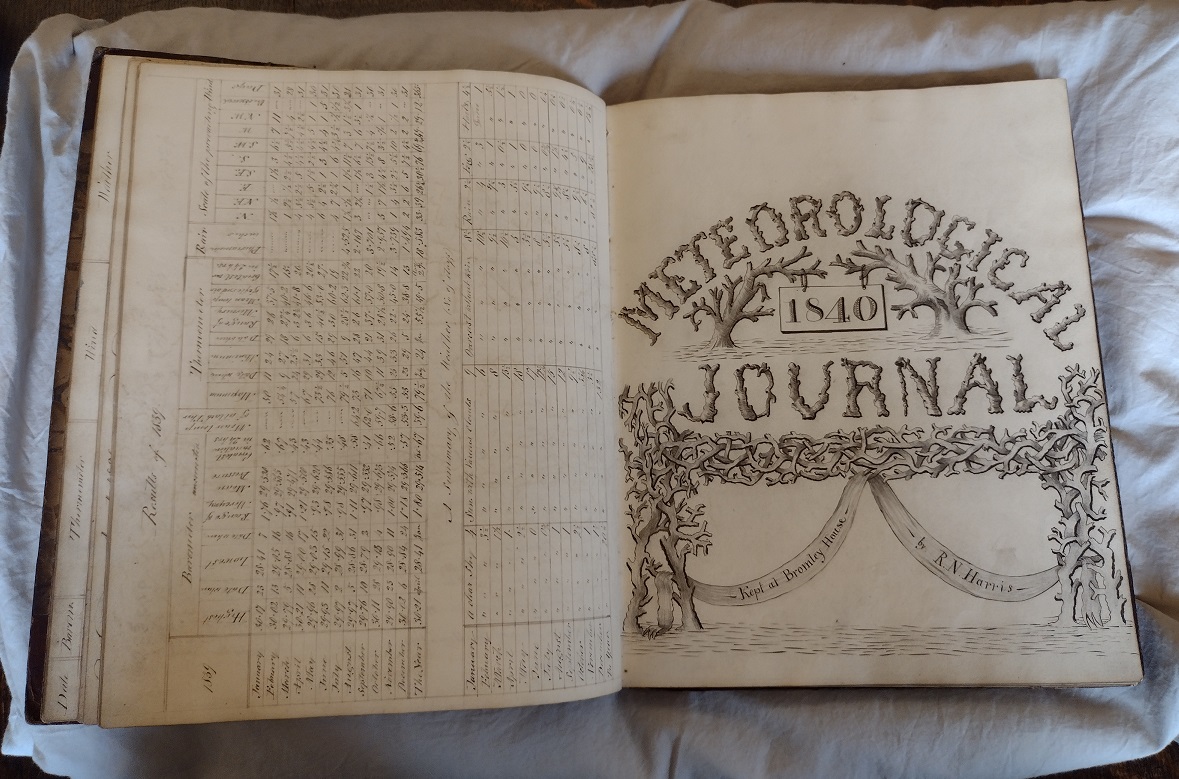
There has been great excitement in the library about a new donation to the collection – a record of the weather at the library, recorded daily over three and a half years in the early 19th century. Anja introduces it, and its story, in the video below (running time c.14 minutes). Notes about the book follow, below the video.
An Amazing New Donation!
We recently received a fascinating and truly unique item for the library collection. A gentleman named Julian Hill had a book which had been passed down through his family, but which he felt should rightly be held here. He found us online, and contacted me to offer this as a donation. It’s turned out to be one of the most exciting things we’ve acquired in recent years!
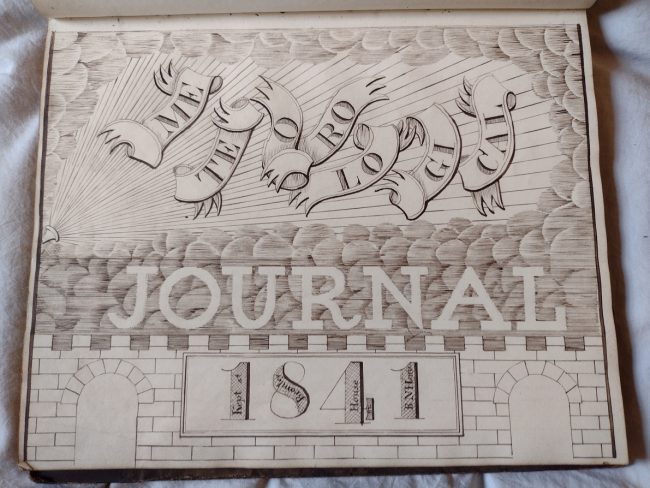
The book is a handwritten journal recording daily measurements of weather conditions, taken at Bromley House, between 1838 and 1841. It includes details of atmospheric pressure, temperature, and wind direction and speed, taken at various times during the day, together with general remarks on the weather. At some points additional information was also recorded, such as the time of sunrise, cloud formations, or the amount of rainfall. The readings are recorded in a beautiful, neat handwriting, and the beginning of each year is marked with a title page, also hand-drawn and very intricate. The title page for each year has a different design.

The journal states that it was compiled by someone named ‘R. N. Harris’. Looking through our archives and previous research shows that the library employed a porter at around this time whose name was Richard Harris. He was appointed in January 1837 (at a wage of 7 shillings per week), and was certainly still working at the library in May 1841, although we don’t know when he left. The weather journal covers September 1838 to December 1841, and it would make sense that the compiler was a member of the library staff, as they would usually be in the building and available to take the readings three or four times per day. It therefore seems likely that ‘R. N. Harris’, who wrote this document, was Richard Harris the library porter.

In 1840 Harris added an extra column to his tables in which he recorded the predicted weather according to ‘J. R. Hind’ (presumably in order to compare it to the actual weather as observed). A bit of digging reveals that Hind was also a fascinating character! John Russell Hind was born in Nottingham in 1823. He was educated at Nottingham High School and seems to have been something of a prodigy. As a youth he published an “Atmospheric Almanac” giving weather predictions for 1839 and 1840, and we know that he donated a copy of this to Bromley House in 1840. (Unfortunately, we no longer have this.) It seems likely that this is the book from which Harris took his forecasts. In that same year, at the age of 17, Hind travelled to London to train as an engineer, but he quickly moved into a role at the Royal Observatory in Greenwich, and went on to have a distinguished career as an astronomer. He died in London in 1895.
Interestingly, amongst this detailed scientific information, Harris’ weather journal also includes some rather more esoteric data. The days of the week are marked using their astrological symbols, and in 1840 there are also symbols for ‘Mutual Aspects’ and ‘Lunar Aspects’, both of which are astrological terms referring to the positions of celestial bodies. The early 19th century was a time when debate was raging about the validity of astrology, and about whether it should, or could, be considered a separate discipline to astronomy. Weather forecasting also came into this debate, since astrology suggested that planetary influences could affect the weather. Additionally, with the discipline in its infancy, and knowledge of meteorological processes very limited amongst the general populace, many saw predicting the weather as akin to predicting life events. In the surviving correspondence of John Hind it’s clear that he was eager to distance the scientific pursuit of meteorology from the mystical predictions of astrologers, so one wonders what he would have made of Harris including planetary notations next to his own predictions!

This journal is a fantastic sign of the intense interest in scientific development which was present at Bromley House in the early decades of the 19th century. The meridian line was laid in our Standfast Room in 1827, and our wind direction dial was also installed in the 1820s. In 1836 the heliochronometer was set up in the garden, and our visitors’ book also shows that we were host to some of the biggest scientific names of the day, such as Michael Faraday who visited in 1835. Taken in this context, these weather readings feel like a natural thing for us to have instigated, and a sign of the lively and active Bromley House community of the time.

The journal will shortly be going to our bookbinder for some light repairs, and will then be available to view in the library, although it cannot be borrowed. In due course we hope to digitise it too, to make it easier to examine the data recorded by Harris. We are very grateful to Mr Hill for donating this fantastic piece of Bromley House’s history!
Anja Thompson-Rohde