
This month’s Special Collections Spotlight Session is presented by Matt and Katie, and showcases five of the fascinating books we hold relating to plants and flowers.
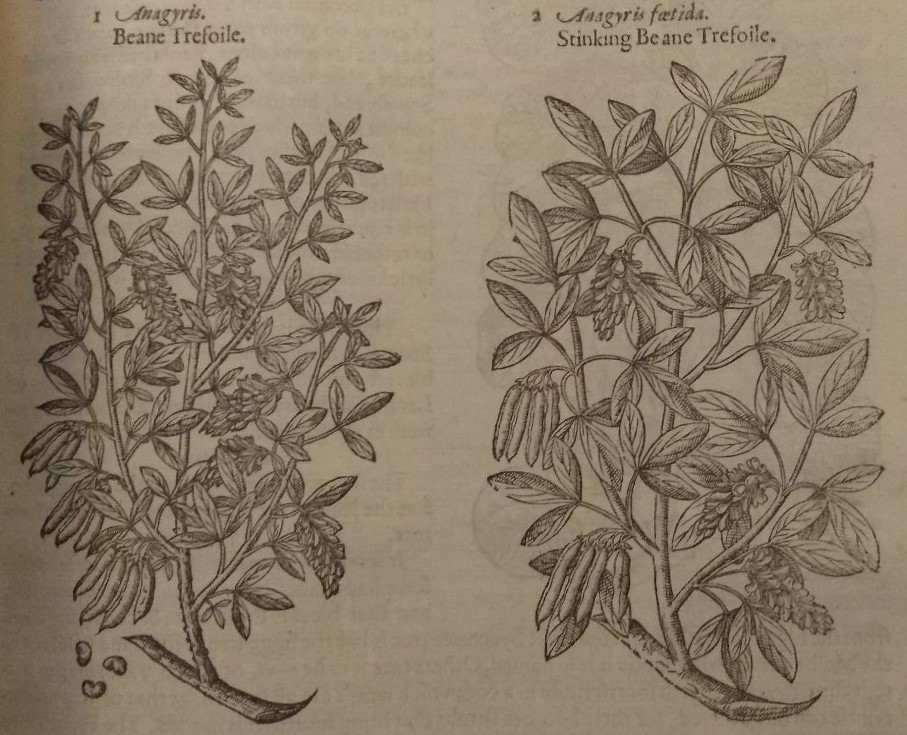
Due to the ongoing Covid restrictions, the session has been filmed and presented as videos, which you can find on our YouTube channel. You can watch all five videos back-to-back by clicking on the image below. The full running time is about 20 minutes.
Notes on the session follow below.
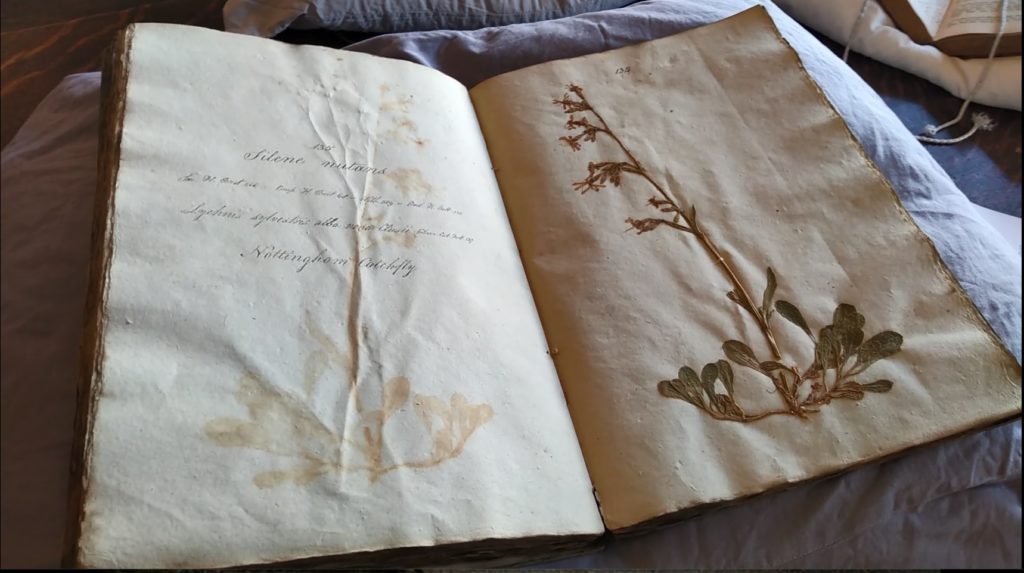
The first work examined is one of the four volumes of Jowett’s herbarium (a collection of pressed and dried specimens of local plants). The herbarium was presented to the library by Thomas Jowett between February 1822 and 1825, and this donation was taken as payment for his library membership. It contains plants collected and mounted by the donor between 1821 and 1824, comprising 299 specimens in total. The volume we have highlighted is Bb 94, compiled in 1822. The herbarium is in remarkably good condition, considering its age, and the plant specimens have been mounted with care and attention to detail. Many of the plants have left an imprint on the facing page, particularly the more mucilaginous specimens, but otherwise they are in very good condition. Specimen 137 in this volume is of particular interest: Nottingham Catchfly, Silene nutans. This is a night-flowering plant, with a heavy scent to attract pollinating moths. It favours limestone, exposed sunny sites, and coastal areas, and it once grew in abundance on the rocky outcrops of Nottingham Castle. That’s where the specimen in the herbarium was collected. Sadly, it is no longer present as a wild plant in Nottingham, or the wider county; its habitat at the Castle was destroyed in the 19th century. However, with the redevelopment of Nottingham Castle museum and art gallery, there is now a project to get this plant growing again in the Castle grounds. We also have some in the garden at Bromley House, grown from seed by Katie!
We don’t have a great deal of information about Thomas Jowett. He was born around 1801 in Colwick, and trained as a surgeon. He was practicing up until 1831, but sadly died the following year. He was a member of Bromley House from 1823 until his death. His contribution to the botanical study of the county was considerable for such a short life, though. In addition to his herbarium, we also hold a collection of botanical newspaper cuttings, penned by Jowett under a pseudonym: ‘Botanical calendar for Nottinghamshire; a series of notices of the plants occurring in the county, which appeared in the Nottingham Journal for 1826 under the signature of Il Rosajo’ [Bb 1347]. Charming and elegant, these calendars provide a year’s overview of not only plant specimens but also weather conditions, topography, land use, and the medicinal properties attributed to the species under discussion. They are also interspersed with poetry and prose – a mix of science and art that blends perfectly for a very engaging read. They could also be an amazing resource and research tool, for instance if one wanted to assess changes in flowering time, distribution and location of species, or the disappearance of species between 1826 and the pressure the natural world is under today.
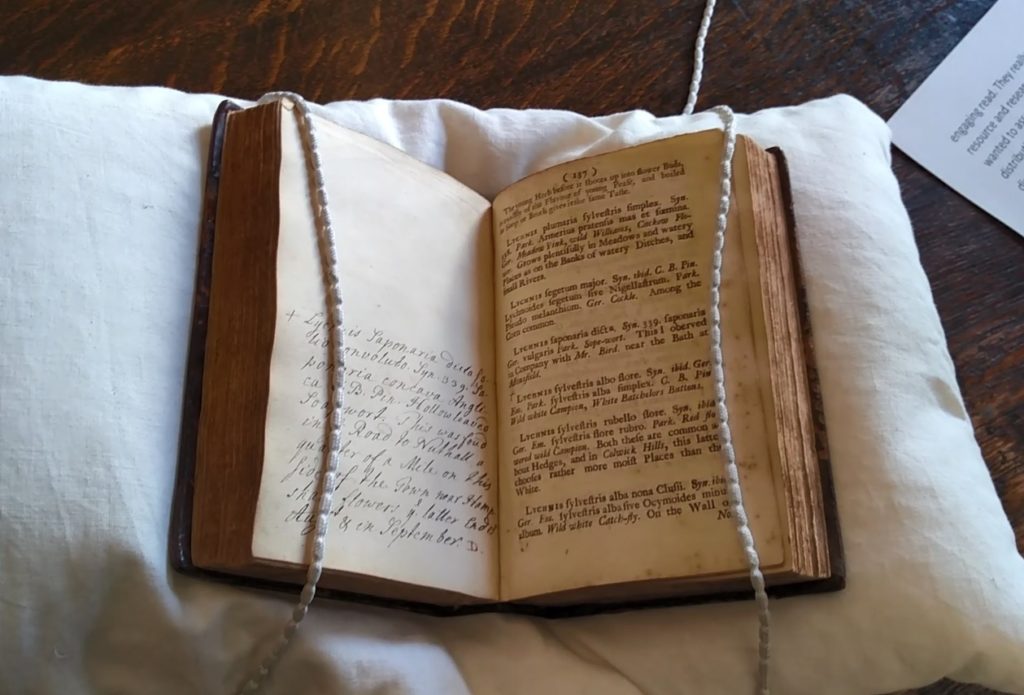
The third book highlighted in this session is ‘Catalogus stirpium, &c. or, a catalogue of plants naturally growing and commonly cultivated in divers parts of England, more especially about Nottingham […]’ by Charles Deering [Bb 2267]. This volume was produced in 1738, so is one of the earliest scientific surveys of its type. It was printed by George Ayscough, who was a Nottingham printer, and was sold by John Rivington at The Bible and Crown, in St Paul’s Churchyard, London. Interestingly, Ayscough’s son Samuel (1745-1804) would later be employed by Rivington, and would go on to become an innovator in library and museum cataloguing and indexing.
Charles Deering was born in Saxony around 1695, and came to London in 1713 as a diplomatic secretary. He then studied anatomy and botany in France, and returned to England in 1719. Whilst in London he joined the botanical society founded by Jacob Dillenius and John Martyn. He was assisted by Dillenius for several parts of his catalogue, particularly in listing cryptograms (plants that reproduce via spores, such as mosses and ferns). Deering died in 1749, and two years later his accomplished History of Nottingham was published.
This particular copy of Deering’s catalogue has notes and marginalia, which are assumed to be in Deering’s own hand, along with an official dedication to William Griffiths, a Royal Naval Lieutenant. This makes it a unique volume, and there is consensus that this was Deering’s own copy. It was put up for sale in July 1824 by a Mr Dowland of Cuckney, together with Deering’s ‘History of Nottingham’. Thomas Jowett and another library member, Thomas Jackson, were despatched to the sale on behalf of Bromley House Library. They bought the ‘History of Nottingham’ for £19 10s 0d, but paid just £1 2s 0d for the ‘Catalogue of Plants’, which seems quite a bargain! This catalogue, and Deering’s contribution to botany, is still celebrated. The genus of plants Deeringia is named after him. The catalogue was used by Thomas Jowett and referenced in his herbarium and botanical calendars.
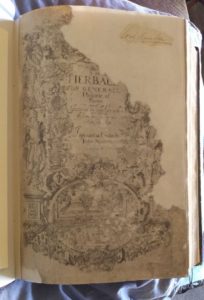
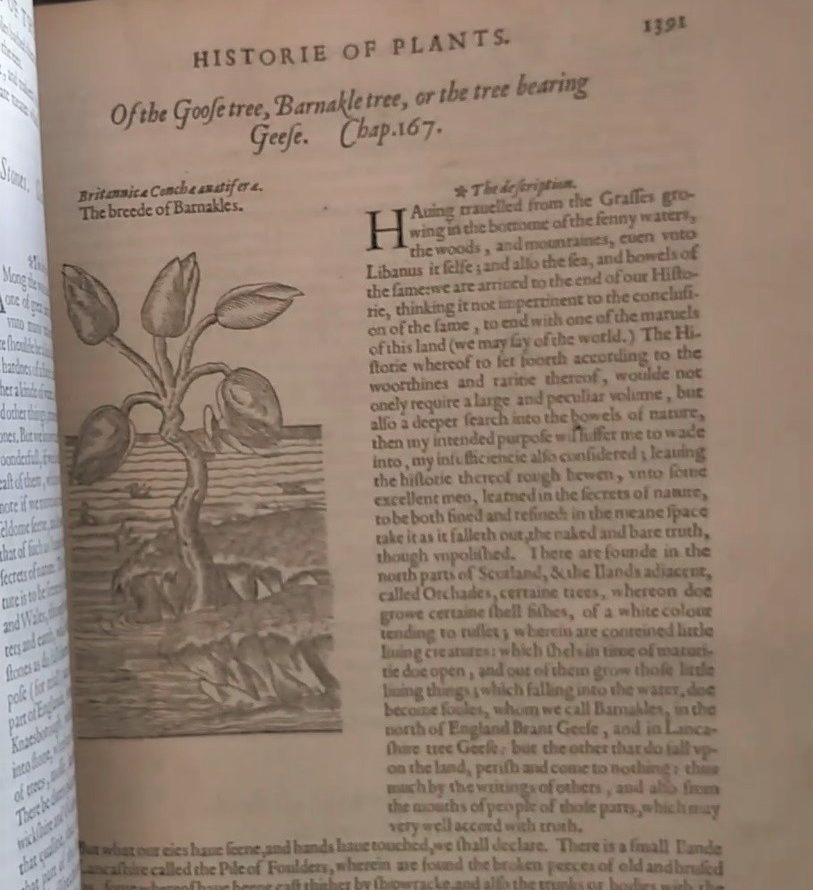
The fourth book in this session is another 2 centuries older than Deering’s ‘Catalogue of Plants’: ‘The Herball or Generall Historie of Plantes, gathered by Iohn Gerarde of London, Master in Chirurgerie’, commonly known as ‘Gerard’s Herbal’ [Bb 87]. Our copy was published in 1597 by John Norton, the Queen’s printer, and was restored and rebound in 2009, thanks to our former librarian Carol Barstow.
 John Gerard was born around 1545, and became apprenticed to a Barber Surgeon in 1562. He worked for a time as the curator of the physic garden of the London College of Physicians, and was well known as a plant collector. In 1596 he published a list of all 1039 plants growing in his Holborn garden, which is acknowledged as the first plant catalogue ever produced. However, there was some controversy over the publication of Gerard’s Herbal, with some (such as Anna Pavord in 2005’s “The Naming of Names” [Bb 3190]) considering that Gerard plagiarised the work. It was, in the first place, a translation of the Flemish botanist Rembert Dodoens’ ‘Stirpium historiae pemptades sex’. The translation was started by a Dr Priest of the College of Physicians, and Gerard only took over the project when Priest died. Despite this, he claimed the entirety of the work as his own.
The book was, however, very successful. Dodoens’ ‘Cruydeboeck’ had already been published in England as ‘A Niewe Herball’ in 1578, so Gerard’s publication was the second herbal to be published in 20 years, which indicates the public interest in the subject at the time. The Herbal includes early illustrations of some now common vegetables introduced from the Americas, including potatoes, which are described as “best boiled and eaten with oile, vinegar and pepper”. There is also an illustration of a Barnacle Goose Tree. This relates to the theory commonly cited in the middle ages to explain the fact that geese disappeared for half of the year, before the idea of migration was understood. It states that Barnacle Geese grew from of barnacles, which in turn grew on trees. Gerard claims to have seen a Barnacle Goose Tree!
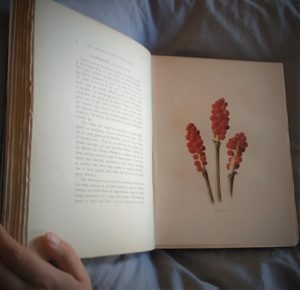
The final book examined during this spotlight session is ‘Wild Fruits of the Countryside’ by F. Edward Hulme [Bb 569], published in 1902. Frederick Hulme was a teacher of freehand and geometric drawing at Kings College, and an amateur botanist. He is perhaps best known for his work ‘Familiar Wild Flowers’, which eventually encompassed nine volumes, the last of which was published posthumously in 1910. The book is part of the Woburn Library of Natural History, which was edited by the Duke of Bedford. Other volumes in the series include ‘The Game Fishes of the World’ and ‘British Mammals’, but we don’t have any of these in the library collection.
This book is really a celebration of Autumn, and the wild berries, seeds and nuts the season brings. It is a joy to read, not only for its beautiful coloured plates, but also for the style of writing. Hulme has an appreciation for nature, and the poetry inspired by nature. The book includes quotes from Shakespeare and Chaucer, amongst others. He also has a dry wit, and takes delight in the kinds of lethal herbal remedies found in earlier works, such as Gerard’s Herbal. These additions and commentary make the book very engaging and fun!
The clippings forming Jowett’s ‘Botanical Calendar’, and Hulme’s ‘Wild Fruits of the Countryside’ are both available for library members to borrow. The other three books cannot be borrowed but can be examined in the library.
Matt Dolman, Katie, and Anja Thompson-Rohde