
The videos for November’s Special Collections Spotlight Session are now available on our YouTube channel here. This month’s session is a bit different from previous ones as it has been put together in collaboration with collections researcher Steve Bates, who has recently completed a mammoth volunteer project to investigate the theology collection. Here he introduces us to the life and work of early 20th century Christian contemplative Evelyn Underhill.
The videos also include information about a discussion group we are hoping to set up based around the theology and philosophy collections in the library – a wide-ranging, open, and non-prescriptive group discussing all the deeper questions of life, the universe and everything! If you would be interested in getting involved in such a group, please email anja.rohde@bromleyhouse.org
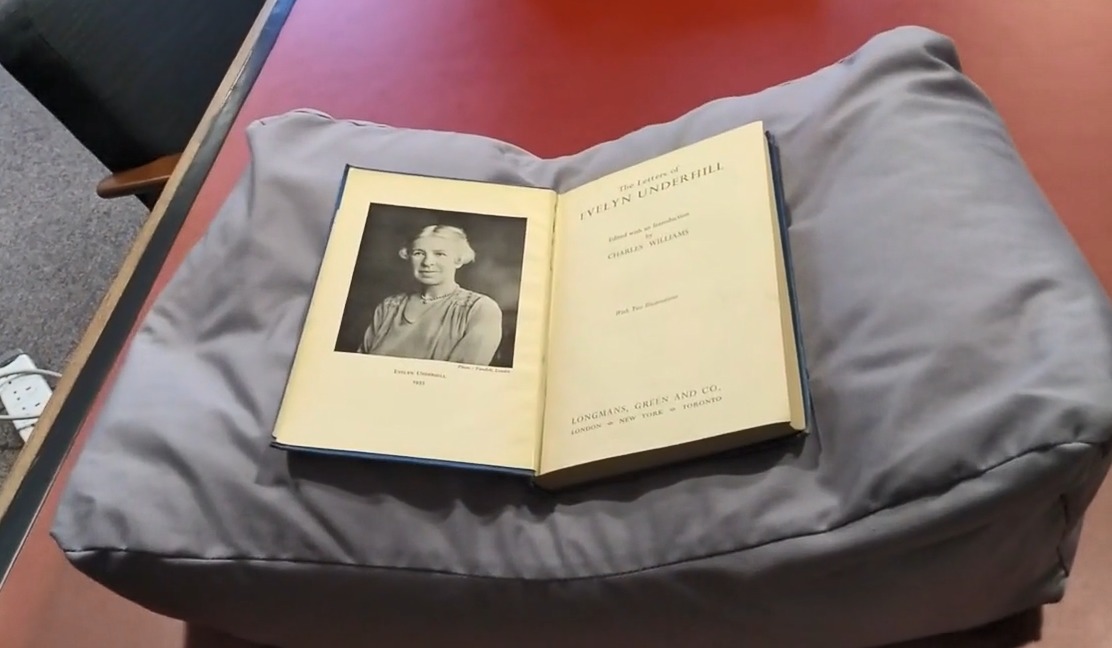
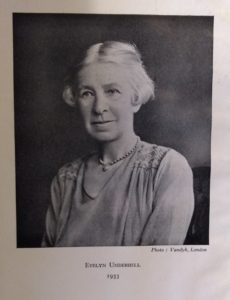 The Theology collection holds five works by the Anglican contemplative, writer and spiritual director Evelyn Underhill. In the biography section there is also a collection of her letters edited by Charles Williams (best known as a friend and collaborator of “The Inklings” – J R R Tolkien and his circle.) [Ca 6024] This book contains a photographic portrait of Evelyn.
Evelyn Underhill’s work emerged from a movement within the Church of England known as Anglo Catholicism (sometimes called Tractarianism from the title of the journal which most closely followed the thinking of this movement ‘Tracts for the Times’). In simple terms this was that part of the Church of England most sympathetic to the practice and teaching of the Roman (Western) Catholic Church. It was very conservative, and was troubled by the perceived laxity within Anglicanism, instead looking back to the devotional qualities of the early church.
Underhill was born in 1875 and lived until 1941. It requires very little imagination to appreciate her social and political background in terms of two global wars, and an uneasy peace, itself followed by a decade-long financial crisis. It was, on that level, a difficult and challenging life. In contrast to the social and political turbulence, however, her personal circumstances were privileged – distinctly upper middle class, with servants, houses, European travel, and good educational opportunities.
In this context, her attraction to the Catholic Church caused some turbulence. Her husband reflected the values and, some would say, the prejudices of his class, opposing her Catholic leanings. She remained a lifelong Anglican.
All this contributes to her almost unique position and achievements. She was a woman writing for, and within, a conservative and traditional portion of her church and society. She exercised a vital ministry in recovering, advocating and teaching an almost lost practice within her church – that of contemplation, or mysticism. In the context of Evelyn Underhill’s work, mysticism refers to the practices, disciplines and beliefs which can lead an individual to a more close personal experience of the divine. It takes inspiration from those members of the very early church who advocated a life of simplicity, and who found God in light and silence, unmediated by priests or complicated ritual. This contemplative practice of prayer, fasting, examination, and charity was by the 19th century largely only practised in cloistered monastic communities. She took the contemplative life out of the nunnery, the monastery and the seminary, and almost single-handedly gifted it to the everyday church community, as well as to a far broader range of clergy, even outside traditional Catholic circles.
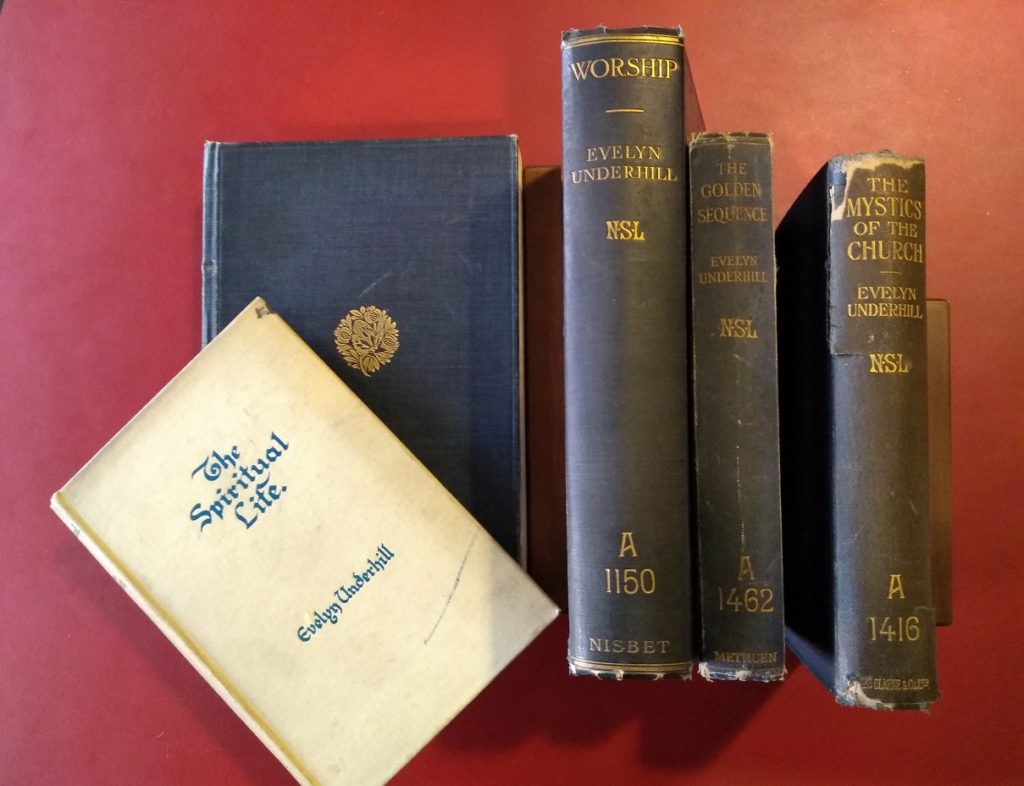
 We hold five works by Underhill in the Bromley House collection. Formidable though her scholarship is, they are all guided and shaped by a deep contemplative practice and a rich sacramental life embedded in the customs of the church. Not for nothing did the Times Literary Supplement in its review of ‘Worship’ [A 1150] describe it as “a masterpiece of the spiritual life […]”. Worship was published in 1936 and, as the name implies, is her study of the full variety of the Christian ritual and liturgical encounter with God.
Unfortunately, the Library does not have a copy of Evelyn’s acknowledged masterpiece ‘Mysticism’, which was published in 1911, a quarter century before Worship. However, we do hold a copy of ‘The Mystic Way’, which 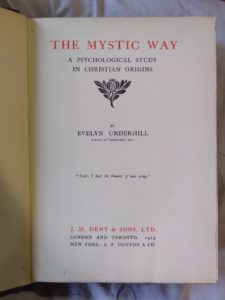 appeared two years later [A 1002]. This is a kind of “beginners’ guide” to the ideas laid out in ‘Mysticism’. In these two most important texts Underhill provides her exposition of the contemplative life, with historical detail and examples, written primarily for a lay audience. She gives details of leading figures and exemplars of the life, right up to modern times, and includes Protestant as well as Catholic figures.
The other three books in our collection may not be as renowned or important as ‘Mysticism’ and ‘Worship’, but they are all interesting and engaging. ‘The Mystics of the Church’ was written in 1925, and digs into the history of mysticism within the Christian church [A 1416]. ‘The Golden Sequence; A fourfold study of the spiritual life’ came out in 1932, and is described in its preface as “a personal little book” [A 1462]. It explores the realities and interpretations of religious experience and tries to bridge the gap between action and contemplation. Finally we have ‘The Spiritual Life; four broadcast talks’ form 1937 [A 1507]. This beautiful little book reproduces four essays originally broadcast on the radio, intended for a general audience. It is therefore written in a more accessible style than some of Underhill’s other work.
 How to sum up this life and work? Her work demonstrates a response to her times: The old certainties of church and society had perished on battlefields and in social breakdown. The prevailing liberal and other Victorian and Edwardian certainties had gone – the confidence in a “God with a plan ” had vanished, eradicating the widespread complacency and expectation of endless economic and political progress and certainty. As one commentator said: “The Church had emerged very much shaken and convicted of dire negligence and ignorance […] Evelyn had something new to say […]”
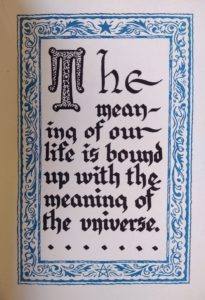 She sought to guide readers and those attending her retreats toward a greater contemplative “reality” – beyond the turbulence and conflict of the human world. She was offering a way toward a Divine Reality; the real place, purpose and point of an authentic human experience. In this she was representative of a wider generation; most notably the poet, publisher and critic T S Eliot who wrote in ‘The Four Quartets’ in 1941:
“At the still point of the turning world, neither flesh nor fleshless
Neither from nor towards; at the still point, there the dance is…..
Without elimination, both a new world
And the old made explicit, understood”
Steve Bates and Anja Thompson-Rohde