
By Anja
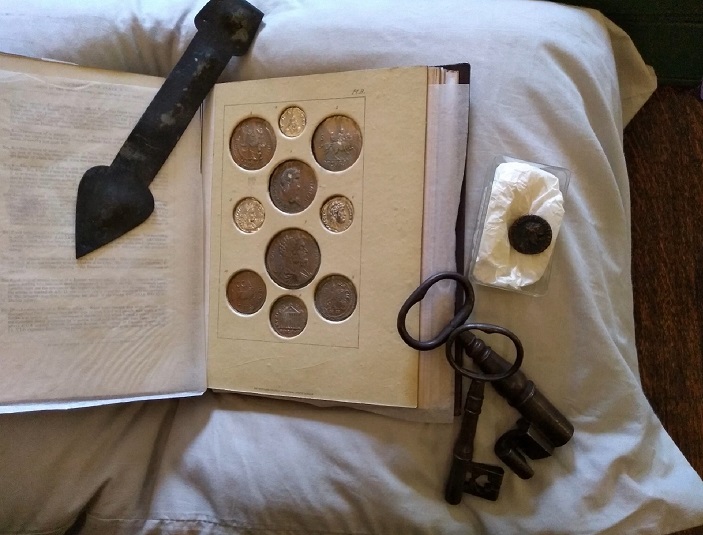
Many of you know that I have a special interest in numismatics, or the study of historic coins. I was therefore quite excited, and intrigued, to find out that within our collection we have a Roman coin. The coin itself is interesting, but it seems somewhat inexplicable that it should be here in the library. To satisfy my curiosity I’ve done a bit of research into the history of the coin, and have uncovered a story which sheds light on the development of Bromley House Library as an institution, and even includes a strange link to the Freemasons. Could this be the next Dan Brown bestseller?!
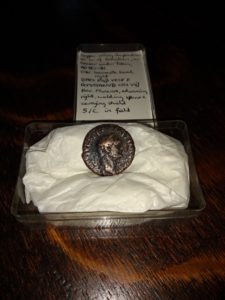
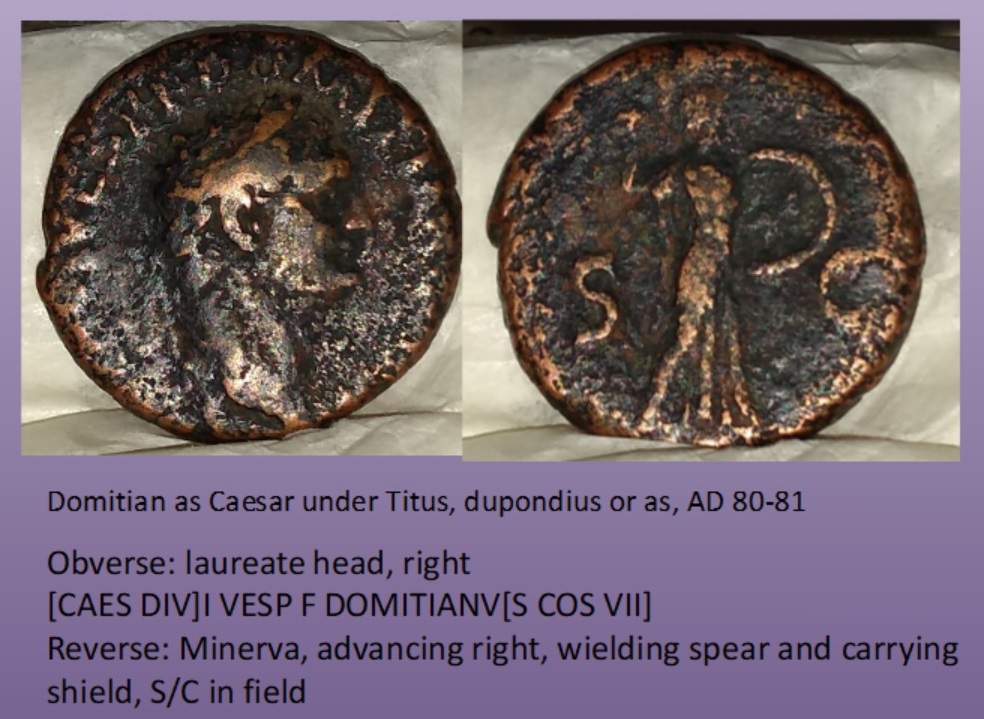 The coin is a low denomination Roman coin struck in the name of Domitian. Domitian was Emperor between AD 81 and 96, but this coin was struck slightly earlier, while he was Caesar (or junior emperor) under Emperor Titus. It has Domitian’s portrait on the front, facing right, wearing the laurel wreath. The inscription around the edge is quite worn and some of the letters are missing, but it gives his name, pedigree and current titles, translating as “Casesar, son of the divine Vespasian, Domitian, in the year of his 7th consulate”. This allows us to date the coin very precisely, since senators held the position of Consul for a year at a time, and there are clear records showing when individuals fulfilled that role. Domitian’s 7th year as a Consul was AD 80-81, so the year before he became Emperor. The coin is either a dupondius or an as (it’s often difficult to tell the difference between the two denominations). A dupondius was worth one eighth of a denarius, and an as was half a dupondius, so this was ‘small change’ – although it’s physically quite large, about the size of a modern £2 coin. It’s made of an alloy of copper, something like bronze or brass. Coins like this are fairly common finds in European archaeology.
This is a clearer example of a coin with the same design, although this one is a different denomination and has a slightly different inscription: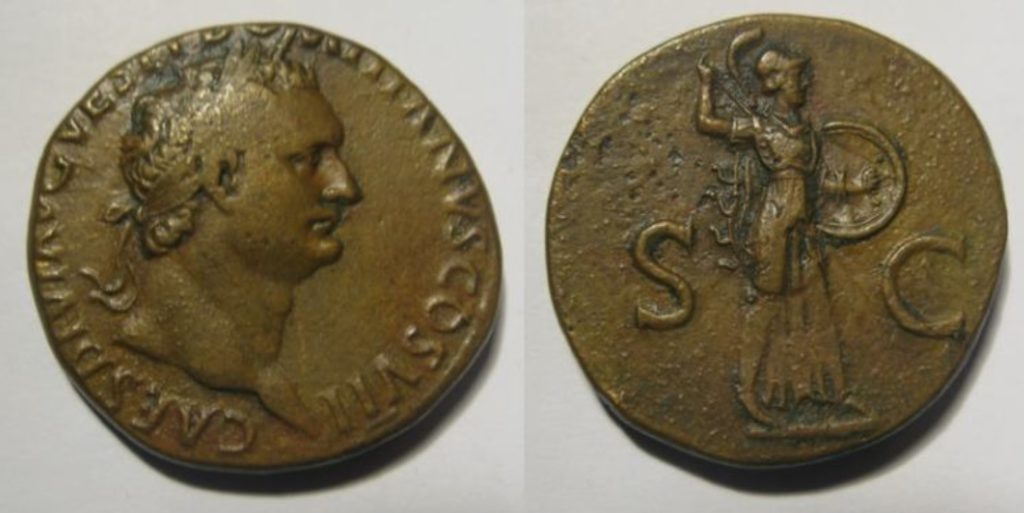
Our coin was found about 15 or 20 years ago in the clerk’s desk at the library (the big, sloping table which is now in the entrance hall). It was examined and identified, but there was no information about where it came from or why we had it, so it was kept as a curiosity and occasionally shown to members; I remember Carol getting it out to show me at my New Members event, when I joined the library six years ago! I’m very pleased to have now had the chance to do a bit of digging and find out more about it.
When Nottingham Subscription Library was set up in 1816 there was a very different culture in the city. There was no general provision of public libraries until the 1850 Public Libraries Act, and the first public museum in the city, Nottingham Castle Museum and Art Gallery, didn’t open until 1878. In the early years, therefore, we fulfilled elements of both roles, with the Library accepting donations of geological, zoological, and archaeological items as well as books. It seemed likely that this early broad remit could explain the presence of a Roman coin, and this was confirmed by a search through our early Committee Minute Books.
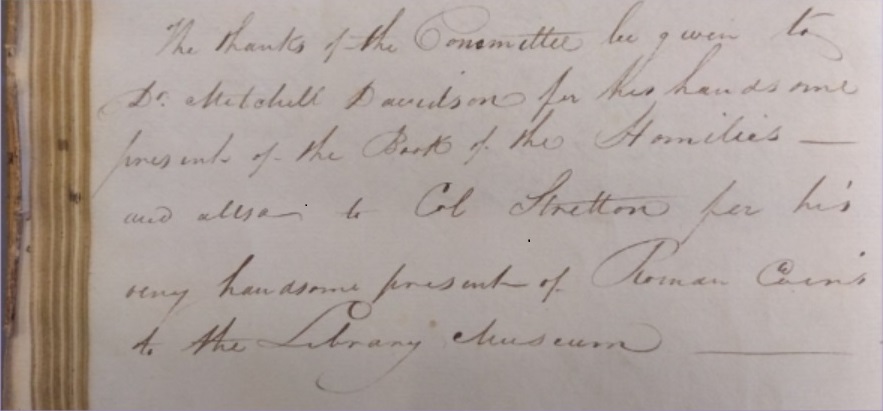 The minutes of the committee meeting held on 6th October 1828 include the note:“[…] the thanks of the Committee be given […] to Col. Stretton for his very handsome present of Roman Coins to the Library Museum’”. Although there is no catalogue of the contents of this gift, it seems likely that our Domitian coin was one of these. It’s also interesting to see that at this time the Committee was specifically referring to a ‘Library Museum’. The donor of the coins was Colonel William Stretton, who was part of the original committee who set up the library in 1816. He remained an active library member until 1832, donating various books and a portrait of Daniel Coke, MP, as well as the coins. I have not been able to establish if he was related to the Nottingham architect and antiquarian William Stretton (1755-1828) whose history of Nottinghamshire, “The Stretton Manuscripts”, can also be found in our collection.
In the later 19th century the decision was made for Nottingham Subscription Library to concentrate on the provision of library services for members, and this was partly due to the formation of other organisations more appropriate to a museum role. Many of the library’s natural history specimens were donated to the museum at Wollaton Hall, for instance. However, in this process, no mention seems to have been made of the Roman coins. Although I have not done a full comprehensive search of the minute books, I couldn’t find any references to the coins for the next 123 years. In fact, it seems clear that they were forgotten about, as the next time they turn up in the minutes, they appear to have been rather a surprise! The notes of the Directors’ Meeting held on 5th February 1952 state that “It was reported that a collection of Roman Coins had been found in the Library”.
 Mrs Holland Walker, wife of John Holland Walker, who was Library President from 1938-1941, offered to clean and identify the coins. In May of that year the Directors minuted an expression of thanks to her for doing this, and noted their decision to have the coins “suitably framed and hung in the Library”. They chose local firm Messrs Lewitt’s for the framing, but the following month there is a minute that a Mr Marriott had been granted permission to borrow some of the coins to show to “Members of a Society to which he belongs.” The minutes from July record his thanks, and the confirmation that he had returned the coins to Lewitt’s.
The initial burst of excitement at the rediscovery of the coins in 1952 doesn’t seem to have lasted long. Just six years later there’s a note in the minutes from 29th July 1958 that Mr Marriott (presumably the same Mr Marriott who borrowed the coins previously) “would like to purchase or borrow the 40-odd ancient coins retained in a frame, which he stated are of particular interest to him.” The Directors seem to have eagerly entertained this idea, and resolved to get the coins valued so they could discuss it further. A further note on this topic from the meeting on 28th October describes them as “42 Bronze Coins”, which as well as being the first indication of the quantity of coins, tells us what they were made of, and thus strengthens the suggestion that our Domitian coin was one of them. The valuation was performed by Mr Iliffe, of Hucknall Road, Nottingham, and set at £10. 10. 0 for the set. The Directors decided to contact Mr. C. F. Pitman, the curator at the Castle Museum, to see if they would be interested in purchasing the coins, which I can imagine must have slightly aggrieved Mr Marriott! However, in the minutes from 27th January 1959 it was recorded that “A member of the Museum staff, who inspected the coins, regretted that they were not of sufficient local interest or value to enable him to put forward any recommendation [for their purchase]”. Mr Marriott may have thought he was back in the running, but if so his hopes were to be dashed again as the minute also states that “It was decided to take no further action at present”!
That’s where the matter rested for the next three and a half years, until in 1962 Mr Marriott brought it up again. The minutes from the meeting on 30th October of that year state that “Mr. Marriott said that he would like to purchase some 42 coins (of small denomination) from the Library which he thought might be used in connection with a Religious Masonic Order in which he was interested.” The sale was agreed, at the value suggested in 1958.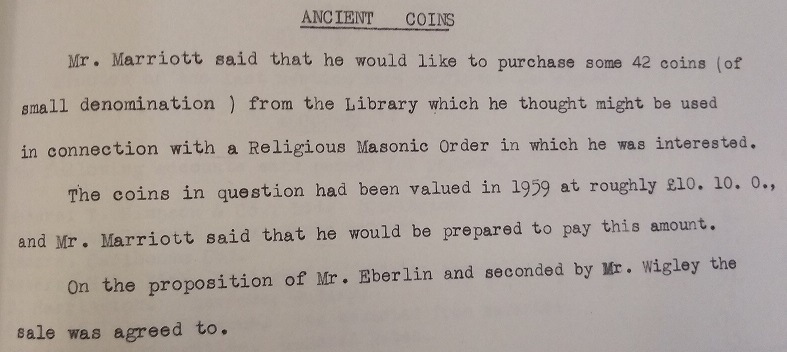
So Mr Marriott finally got his hands on the coins, and more interestingly, he acquired them for the use of the masons! I couldn’t stop my research there, so I did a bit more digging. Mr Marriott turned out to be an interesting character, and was involved in a bit of scandal at the library! It is most likely that the notes refer to Mr John Marriott, who was a member of Bromley House from 1945 to 1966. He was an estate agent and valuer, with the family firm of George Marriott and Sons. In 1948 the library decided to employ his firm to collect the rents owed to them. However, in 1955 it was noted that the commission he was charging for the role of rent collector was 3.75% of the rents, amounting to £110. 0. 0., where ‘a few years earlier’ the commission paid to the rent collector was only £10. 0. 0. This was questioned at a committee meeting in that year, at which point Mr Marriott got very angry and stormed out of the meeting threatening to resign from the library! He didn’t actually resign, but the contract for rent collection was taken from his firm and in September 1955 it was agreed that the rents would henceforth be collected by the Secretary instead. If this was the same Mr Marriott who later purchased the coins, this bit of bad blood may explain why he didn’t press his request at the point where the sale was turned down by the museum.
I found a further snippet of interesting information in an essay on masonic history on the website of the West Yorkshire Division of the Order of the Red Cross of Constantine https://redcrosswestyorkshire.co.uk/ . The essay is entitled ‘The Masonic and Military Order of the Red Cross of Constantine and the Orders of the Holy Sepulchre and Saint John the Evangelist; A celebration of 100 meetings of the West Yorkshire Division’ and is written by Tony Llewellyn, Intendant General. It includes the following note:
“On Monday 17th September 1962 a special meeting was held at the Masonic Hall, Goldsmith Street, Nottingham, where Illustrious Knight John Marriott, a member of the Nottingham Conclave No. 180, was appointed and invested as Deputy Intendant General by Very Illustrious Knight Nutt in the presence of the ninety-three members of the Division.”
 If this was our Mr Marriott, it suggests that this may be the ‘Religious Masonic Order’ for which he purchased the coins. I have sent an email enquiry to the Nottingham Freemasons to see if they can provide any more details about Mr Marriott, or even better, if they have any record of the use of the coins. I await their answer with interest, but in the meantime I’m very pleased that we still have this coin. If it was part of Col. Stretton’s 1828 donation, it must at some point in its history become separated from the rest of the set, and ended up remaining in the library when the rest of the coins were framed and hung, and then passed on to Mr Marriott and the masons. This one small object reveals much about the changing purpose of Bromley House Library, the decision-making of our committee, and the personal history of some of our members.