

In keeping with the spooky season, the topic of the Special Collections Spotlight Session for October is “Ghosts and ghouls”. Anja introduces four of the more sinister items from the older parts of the library collections.
As with previous sessions, the restriction on groups gathering together in light of the Covid-19 virus situation mean that this session couldn’t take place in person in the library. It is instead presented as a series of four videos on our YouTube channel. You can find them individually by searching for ‘Spotlight: Ghost and ghouls’, or you can watch all four back-to-back by clicking here. The total run-time is about 20 minutes.
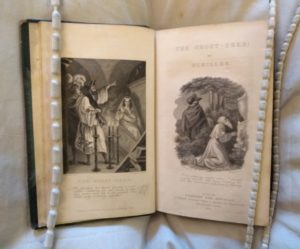 The first item in the session is one of the earlier examples of ghost fiction. ‘The Ghost-Seer! From the German of Schiller’ [Dc 2109] was published in 1831. As the title suggests, it is a work in translation, although no details are provided about the translator. It’s an English version of ‘Der Geisterseher’ by Friedrich Schiller, which was originally published in serial form in the journal Thalia from 1786 onwards. Although it was never finished, it was first published as a book in Germany in 1789. It is a work in two parts, here bound together into one volume. The story is written in the first person, purporting to be an eye witness account by the ‘Count of O-‘ of a young German prince’s visit to Venice at carnival time, during which trip he is accosted by a secret Jesuit society intent on converting him to Catholicism, and thus extending their influence into Protestant Germany. The book therefore deals with issues of philosophy and religion, as well as more Gothic melodrama.
Johann Christoph Friedrich von Schiller was a German philosopher, historian, playwright, and poet, who lived from 1759 to 1805. He was an associate of Goethe, and all his works contain strong philosophical elements. His philosophy has been described as liberal and cosmopolitan, and he published many works critiquing religion and society; a theme which runs strongly through Der Geisterseher. Despite being unfinished, this was his most popular book, both in his lifetime and afterwards, although its popularity probably owed more to the Gothic elements of the story than to its theology!
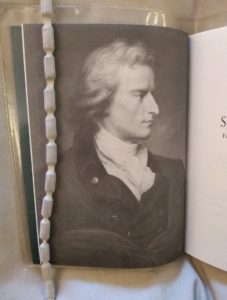 We actually have two versions of the book in the library collection. In 2003 a new translation was published by Pushkin Press. This has the title ‘The Man who sees Ghosts’ [Dc 23290] which is a much more anglicised syntax than the more literal translation of the title on the 1831 book! The text of the 2003 version is also much more modern in style, and to a modern eye, much easier to read. This rather handsome little volume includes a portrait of Schiller as its frontispiece.
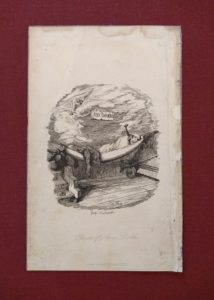
The second item highlighted in this session is a single sheet illustration which seems to have been removed from a book. It can be found in a large portfolio of documents, which is catalogued as ‘Nottingham Sketches’ by Mrs Enfield et al [E 50]. This folder contains three prints of sketches by Anne, wife of William Enfield who was an alderman of Nottingham in the mid 19th century. Anne Enfield, née Needham, was born in 1801 and was an artist in watercolour and sketches. The prints are part of a set which was published in 1854 in support of the Midlands Institute for the Blind. The portfolio which bears Mrs Enfield’s name, however, also includes a number of other documents which seem unrelated to the Nottingham Sketches. One of these is an illustration entitled ‘The Ghost of Ann Dobbs’ by George Cruikshank.
George Cruikshank was a renowned satirical illustrator and caricaturist who lived from 1792 to 1878. He illustrated many popular novels, such as the works of Dickens, and also created political cartoons. He had some interest in the occult, from the point of view of a rationalist and materialist; at one point he offered a reward of £100 to anyone who could show him a ghost which was popularly believed to haunt a site near Leicester at the time, and throughout his career he seems to have gently mocked belief in the supernatural. ‘The Ghost of Ann Dobbs’ appeared in an 1838 book of naval anecdotes called ‘Land Sharks and Sea Gulls’ by Captain William Nugent Glascock. It accompanies the tale of a sailor who took a portion of a gravestone to use as holystone for scrubbing the deck of his ship. (Holystone is the name given to a type of sandstone used for this purpose, possibly due to the rumours that gravestones were a common source for it.) The ghost of the lady commemorated by the gravestone, Ann Dobbs, appeared to the sailor to rebuke him for thus disrespecting her final resting place. The illustration shows the sailor in his hammock, terrified by the ghost which hovers over him pointing to the portion of her gravestone in condemnation. This illustration was described by Cruikshank’s biographer W. H. Chesson as the ‘chef d’oeuvre of [his] ghost humour’.
For the third book in this session I turned to one of our named collections; the Brunner Collection. This is a group of foreign language books, mainly in French, which previously belonged to Adolphe Brunner, and were donated to Bromley House by his mother, following his death. Brunner was an Austrian national, born in 1852, who moved to England with his family, and was naturalised at the age of 24. The foundation of his impressive book collection was the proceeds from the Napoleonic Award for Best Foreign Language Student, which he won three times as a youth. As an adult he became a teacher at Nottingham Boys’ High School, and his obituary from the Nottingham Guardian notes that by the time of his early death at the age of just 29, he was Senior Classics Master at the school. The Brunner Collection is available for loan, and is currently housed on the shelves behind the counter.
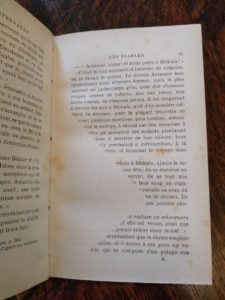 The particular volume which I want to highlight in this session is ‘Curiosités Infernales’ by “P. L. Jacob, bibliophile” [Dd 3100]. This is a pseudonym of Paul Lacroix, who was a renowned author and journalist in his native France. He lived from 1806 to 1884, and wrote both novels (mainly historical romances) and academic works of history. This volume was published in Paris in 1886, and has additional interest because one of the pages has a printing error – on page 81 it is clear that another sheet of paper was overlaying the page when it was printed, and has blocked the printing of part of the text. There is now a triangular blank across the page where the erroneous sheet was sitting!
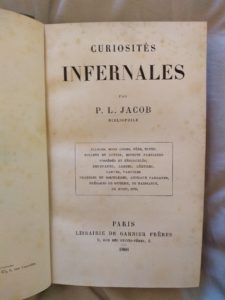 Even for someone with my ropey French skills the title and chapter headings in the book provide ample indication of the subjects discussed. There are chapters on devils, angels, the fae, possessions, werewolves, spells, spirits, wonders, and omens, as well as a large section on “The Empire of the Dead”, which includes discussion of spectres, phantoms and other types of ghost. Without being able to translate the book, though, I am uncertain whether these phenomena are presented as fact, or merely as the subjects of folklore and tradition. Nonetheless, in light of Lacroix’s publication of other well-researched books of history, I suspect the latter.
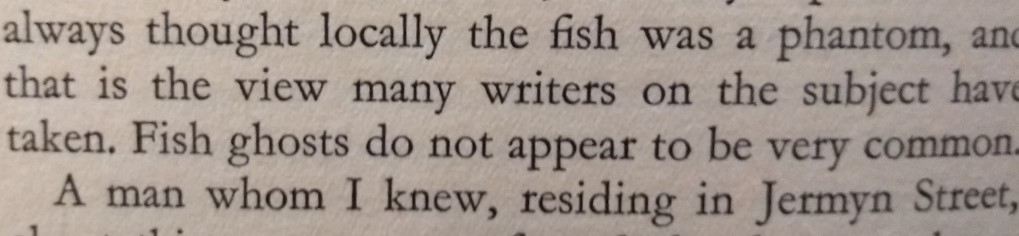
The final book in this session, however, does certainly present its contents as fact. This is ‘Family Ghosts and Ghostly Phenomena’ by Elliott O’Donnell, published in 1933 [Cc 01873]. It is a discussion of supernatural occurrences which are said to attach themselves to particular families, usually appearing as portents of death or other misfortune. It includes, for example, the wonderful local tale of the ghost sturgeon of the Cliftons of Clifton Hall, which is seen in the Trent near Clifton Grove whenever a member of the family is about to die! O’Donnell ends his description of this rather far-fetched tale with the very deadpan sentence “Fish ghosts do not appear to be very common.”!
Elliott O’Donnell was a hugely popular author in his time. He was born near Bristol in 1872 and lived to be 93. He had an interesting and varied career, having travelled to America and worked on a cattle ranch in the late 19th century, before spending time as a policeman during the Chicago Railway Strike in 1894. He then returned to England and worked as a schoolmaster, before training as an actor. 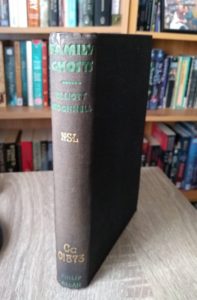 He served in the army in the First World War, and after the war he acted on stage and in films. His first book was published in 1904, and he went on to write several novels, but he gained most of his popularity through books of ‘true’ ghost stories. He developed a reputation as an expert, and in later life he lectured on occult matters, both in person and on television and radio. His penchant for theatricality and performance can be seen in his writing too; although he seems to have genuinely believed in the tales he is presenting, they are given with an excellent dramatic air, which makes them engaging and very entertaining to read! We have three of his books in total – ‘Rooms of Mystery’ from 1931 [Dd 1282] and 1951’s ‘Ghosts with a Purpose’ [Dd 1498], in addition to ‘Family Ghosts’.
The books highlighted in this session are all available for loan, although the Cruikshank illustration is not; you can, however, examine it in the library. Please ask a member of staff if you want to view it during your booked visit!
Anja Thompson-Rohde