
Special Collections Spotlight Session July 2020
Due to the restrictions on gatherings in place to slow the spread of the Covid-19 virus, this event was filmed and presented as videos. You can see them on our YouTube channel here: Spotlight: English Churches Some notes on the books discussed follow!
This month’s spotlight session looks at books in the Special Collections which relate to the architecture and history of churches. The list of relevant books is extensive! So much so, in fact, that I had to filter the selection; this session just looks at English churches, and there will be a further session in future looking at continental buildings.
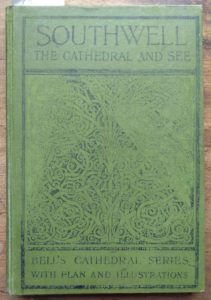 There are a number of different types of books in the collections which deal with churches. One of the more common is books which describe an individual building, and lots of those are focussed on local churches. We have a few discrete collections which feature many books of local history, such as the James Ward Collection, and the Michael Dobbin Collection, and these are a particularly rich source for books about local churches. As an example, there is the 1898 book ‘The Cathedral Church of Southwell: a description of its fabric and a brief history of the episcopal see’ by Rev. Arthur Dimock, M.A. [MD/4 (312)]. This book is part of Bell’s Cathedral Series, which was published in the late 19th and early 20th centuries. Rev. Dimock contributed two books to this series – the book on Southwell, and also the one on St Paul’s Cathedral in London. The series was published by George Bell and Sons, and its intention was two-fold: “to produce a work compiled with sufficient knowledge and scholarship to be of value to the student of archaeology and history, and yet not too technical in language for the use of an ordinary visitor or tourist”; a kind of erudite guidebook. This one contains information on the church building, as well as notes on its history, and is illustrated throughout with photographs and drawings. We have a few of the books from Bell’s Cathedral Series in the collections.
Another similar book is ‘St Mary’s Church, Nottingham: its past and present history’ [JWC/2 (81)]. This too is a guidebook to the church, including descriptions of the building and its history, with illustrations. This book is older than the Bell’s book, though, having been published in 1874. Interestingly, it has no named author. Instead it just notes that it was published by Richard Allen & Sons, of Nottingham, and that they also provided the photographs. The photographs are not printed onto the pages of the book; they have been printed separately and stuck in. Allen & Sons are known as a photographic studio, producing cartes de visite and other photographic material. They were based in Caxton House, which was at 34 Long Row, and seems to have been a photographic studio for a number of years, under different owners. The production of this guidebook to St Mary’s church may have been as much an advert for the photographers as a souvenir of the church. The six photographs which show the church in the 1870s are certainly lovely to see!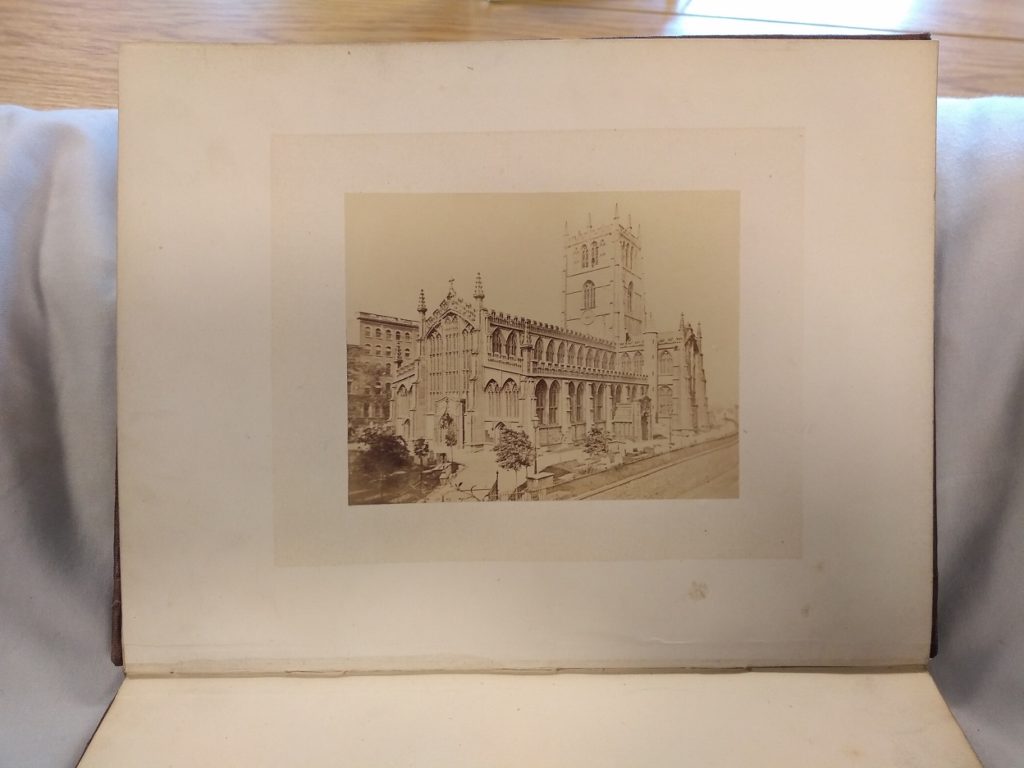
The next books in this spotlight session are also descriptions of local churches, but these particular examples are unique. Within the James Ward Collection we have a set of three bound volumes which are the author’s manuscript copy of ‘Notes on the Churches of Nottinghamshire: Hundred of Rushcliffe’ by John Thomas Godfrey [JWC/4 (224) – (226)].
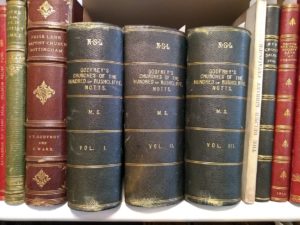 They comprise the text of the book, typed in parts, but mostly handwritten, with corrections, amendments, and notes as it was edited before publication. There are also notes on the typesetting and illustrations, such as the frontispiece with its dedication to the Archbishop of York. Fortuitously we have the published version of the book in the library too, and it’s fascinating to compare the manuscript notes with the final printed version! Godfrey was born in Lenton in 1857, and lived until 1911. He developed a reputation as a local historian, and was a member of the Royal Historical Society. This work was published in 1887, and he also wrote similar works on the churches in Nottingham, Lenton, and the Hundred of Bingham. Part of the financial backing for these publications came from James Ward. Ward clearly respected Godfrey’s skills as a researcher, and was known to employ him to transcribe and edit historical manuscripts which he had acquired.
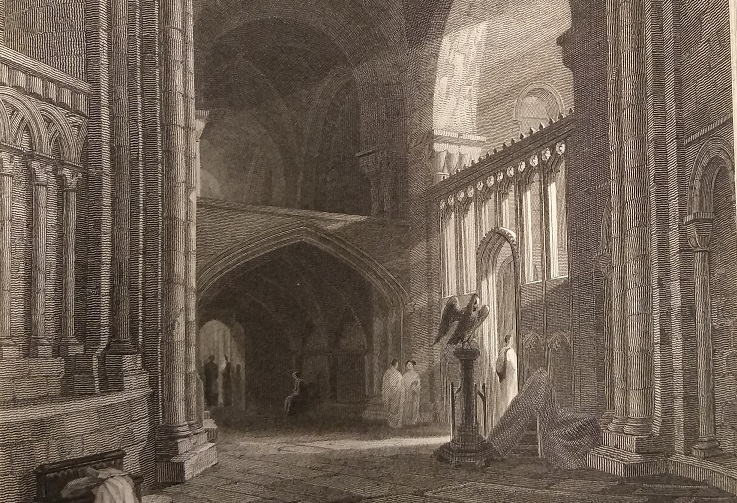
As well as local churches, the collections also include books relating to buildings around the rest of the country. We have, for example, a number of the books in the series of ‘Cathedral Antiquities of England’, written by John Britton, and published between 1814 and 1835. Britton was born in Wiltshire in 1771 and had a hard upbringing, being orphaned at a young age and often being in poverty. He tried his hand at various jobs, but got his big break when he was commissioned by a Salisbury publisher to write an account of Wiltshire. This was ‘The Beauties of Wiltshire’ (co-authored with his friend Edward Wedlake), which was published in 1801 and became the first of a nine volume series on ‘The Beauties of England and Wales’. The series was very popular, and Britton went on to write a series on ‘The Architectural Antiquities of Great Britain’, as well as the Cathedral Antiquities, and other similar works. 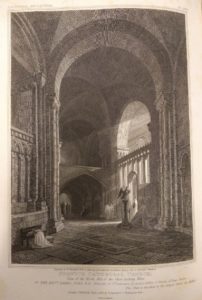 These were instrumental in developing and popularising this type of topographical work which was increasingly common in the Victorian period (and later). This particular example is ‘The history and antiquities of the See and Cathedral Church of Norwich, illustrated with a series of engravings, of views, elevations, plans and details of the architecture of that edifice, including biographical anecdotes of the bishops, and of other eminent persons connected with the church’ [Cc 737]. It therefore includes historical, artistic, and architectural information on the cathedral, and it is clear that the previously mentioned books are a natural development of this type of work. The engravings include factual views of architectural details but also atmospheric scenes of church life.
Moving away from books describing specific buildings, we also have a number of works which look at the edifice of ‘the church’ in its social and architectural context. The first one which I wanted to share in this session was initially chosen just because of it’s cute and rather amusing title: ‘The Village Church in the Olden Time’ [JWC/2 (79)]! It was written by Harry Gill and initially published in 1901, although this copy is the second edition, from 1903, and has an inscription on the flyleaf gifting it to James Ward from the author. The book is very nicely produced, with a gilt and embossed cover and pages printed on glossy art paper. 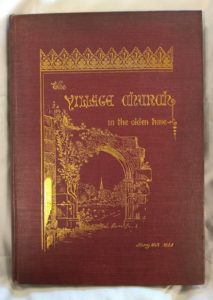 The text includes a great number of illustrations, both photographs and drawings, and describes the place of the church within village life, linking its architecture to its function. The author was a noted Nottingham architect, born in 1858. He designed domestic buildings and churches, some of which are still extant, including houses on Station Road, Beeston, as well as Ripley Methodist Church, and Hyson Green Congregational Church (now the Boulevard United Reform Church). After the First World War he also designed a number of war memorials, such as those in All Saints Church and the Shire Hall in Nottingham, and the memorial in Radcliffe. He was a Licentiate of the Royal Institute of British Architects, as well as president of the Nottingham and Derby Architectural Society. The illustrations in ‘The Village Church…’ are mostly taken from examples in Nottinghamshire and Lincolnshire.
The final book in this spotlight session is one of the most influential books on church design. It was written by Augustus Welby Northmore Pugin, who lived between 1812 and 1852, and was one of the innovators of the revival of the gothic architectural style in early Victorian Britain. Pugin’s father was a French draughtsman who had fled to London during the revolution. His son became a renowned architect, following his father’s interest in gothic architecture. He is most remembered as the designer of the interior of the Palace of Westminster (the Houses of Parliament) and its clock tower (which houses the bell Big Ben). He also published some important critiques of the fashion for gothic architecture which particularly took off in Britain following the Church Building Acts of 1818 and 1824. In 1836 he published ‘Contrasts’ which took a rather harsh view of contemporary building projects, comparing their hasty erection and ‘shoddy’ design and build with examples of sturdy, well-designed gothic buildings from the medieval period. 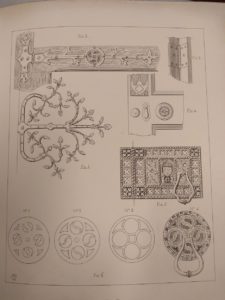 This book is the follow-up, published in 1841: ‘The True Principles of Pointed, or Christian, Architecture, set forth in two lectures delivered at St. Marie’s Oscott’ [E 262]. This book sets out examples for the design of churches, with all their fixtures and fittings, in the gothic style, highlighting how they can best be designed to fulfil their necessary functions. It encourages contemporary craftsmen to study the extant medieval examples, and to emulate their methods of design and construction as well as their aesthetic. The fact that the lecture on which this book was based were delivered at St. Marie’s Oscott is also significant. Pugin converted to Catholicism in 1834, which was at that time still a controversial thing to do. St Mary’s at Oscott in Birmingham is a Catholic seminary college, so by including its name conspicuously in the title of this work, Pugin was publicly proclaiming his faith. The new college building at Oscott, which opened in 1838, was designed by Pugin.
Pugin was incredibly influential in his life-time, but his reputation suffered after his death, partly because of the hostility of John Ruskin, who didn’t esteem Pugin’s design or workmanship. Ruskin’s opinions were loudly proclaimed, and respected, and Pugin became somewhat denigrated. However, a number of important later artists were very heavily influenced by his ideas and his work and legacy is now acknowledged.
The books highlighted in this session are not for loan, but are available for members to read in the library. The majority of the James Ward collections is housed in the Thoroton Room, on the bookcases to the left of the fireplace, and can be taken from the shelves to read, once we are back in the library.
Anja Thompson-Rohde