

Spotlight on… Coins and Tokens
(Special Collections Spotlight Session March 2020; presented as videos due to the closure of the library during the Coronavirus crisis)
The classification system at Bromley House includes the section Cc, described as “Antiquities, including numismatics”. The early catalogues show many books which could be classified as numismatic – relating to the study of coins, tokens, medals, banknotes, and other items which act as money (so-called ‘paranumismatica’, which is a brilliant word!). While some of these have been removed from the collection over the years, there are still a number of fascinating items with this remit, and since coins and tokens are my particular area of expertise, I couldn’t resist choosing this topic for a Spotlight Session!
The first book selected is the snappily-titled “Ancient Coins and Medals: an historical sketch of the origin and progress of coining money in Greece and her colonies: its progress with the extension of the Roman Empire: and its decline with the fall of that power” by Henry Noel Humphreys (Cc 1268). Humphreys was an illustrator, naturalist and numismatist. He was born in Birmingham in 1810, and studied in Italy as a youth before returning to Britain around 1840. He died in London in 1879. He is remembered for his detailed book illustrations, particularly for the natural sciences, including work on British butterflies. He also studied coins and wrote, as the Dictionary of National Biography rather sniffily puts it, “some popular numismatic handbooks, useful in their day”! This book, published in 1850, is one of those handbooks.
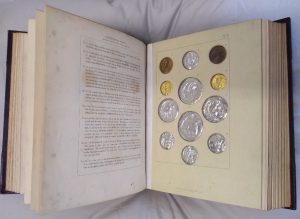 One of the most interesting aspects of this work is the way in which it is illustrated. Rather than including drawings of the coins, it instead includes plates described as showing “fac-simile examples in actual relief, and in the metals of the respective coins”. In other words, each plate has circles of metallic foil pressed into the shape of the coins. Examination of the pages seems to suggest that these were created in some kind of starched fabric, presumably impressed onto actual coins while wet, such that it held the impression of the coin when it dried. It was then covered with a layer of foil in the colour of the original coin (although not in the actual metal, as suggested by the title: where damage has occurred to some of the impressions of gold coins, for instance, it can be seen that the metal foil is silver-coloured beneath the surface!). This technique is fascinating and very effective, and seems to be quite a rarity!
While the first book examined the coins of ancient Greece and Rome, the second book relates to the UK, and in fact is even more local, as it looks specifically at Nottinghamshire. This is John Toplis’ “Seventeenth Century Tokens of Nottinghamshire” (Cc 749).
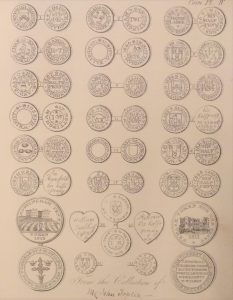 In the recent history of the UK there have been two periods when tokens were widely used in lieu of official coinage. The first of these was in the early part of the reign of Charles II, in the late 1660s. At that time there was a shortage of small change coming from the royal mint, so local business owners started to make their own small coins. These are fascinating as they usually name the business owner, and the town where they were working, as well as having some very endearing designs on them! They are a great record of the commercial life of late 17th century English towns, and they often name people who otherwise don’t appear in the written records of the time, including a number of women who were clearly business owners in their own right.
The author, John Toplis, was a Nottingham man, who lived between c.1839 and 1889. He was a well respected numismatist, and published many articles in local and national journals. He doesn’t seem to have been a member of Bromley House, but there is a tenuous link since he is recorded in our archives as having collected our rates, in his capacity as a Nottingham rent collector! More specifically, the frontispiece of the book has an inscription and signature recording its donation to Bromley House Library by the author, on its publication in 1884. When Toplis died, many of the tokens in his own extensive collection ended up at Nottingham City Museums.
Tokens also feature prominently in a book from 1789 by Walter Merrey. As was common at the time, it has a similarly long and expressive title to the Humphreys book discussed above, but is generally just referred to as “Remarks on the Coinage of England” (Cc 1333). The previous two books can be seen as scholarly numismatic works, examining the coinage of the past from academic interest. There is an element of that in Merrey’s work too, but it also has an important role as a political statement. The treatise uses a discussion of historic English coins to highlight issues with the contemporary ones.
 This book was written during the second period of recent history where tokens were circulating widely in place of official coinage. Again, this was partly due to a lack of small change being struck by the mint, but at this period it was exacerbated by a number of other factors, including increasing industrialisation, which meant many more people working for wages rather than for themselves, inadequate provision for shipping minted coins to the urban and manufacturing centres across the country where they were needed, and intense problems with debasement and forgery of the coinage. Merrey places the responsibility for this firmly with the government, and particularly with their overvaluation of the worth of gold. The treatise is very complex, with a lot of dense detail about weights and assay, so I wouldn’t recommend it to anyone except a hardened numismatist, but the core premise is very intelligent and politically interesting.
As well as being an accomplished numismatist Merrey was a businessman. He was baptised in York in 1723 but seems to have come to Nottingham as an apprentice, and remained here. He worked his way up to being a Master Hosier, which meant that he employed a number of people to make stockings for his business. He seems to have been genuinely concerned by the way the problems of the coinage were affecting his employees, and he signed an association with other local employers to promise that they would not pay more than 6d of their employees’ wages in copper, instead of the official silver coinage. The copper in question is most likely the copper alloy tokens which were prevalent at the time. These were mainly produced by large industrial concerns, such as mills or mines, specifically in order to pay their workers. In some cases the tokens were only redeemable in the works shop, so having paid the copper over to their workers, the tokens came straight back to the pockets of the business owner! However, the general shortage of small change for everyday transactions meant that tokens soon started to circulate more widely as well. In addition, they rapidly acquired an extra usage; it quickly became fashionable for the leisurely rich to collect the tokens. Some manufacturers even started making special edition tokens specifically for the collectors’ market. The first catalogue of tokens as collectors’ items was compiled by James Conder in 1798, and they are still commonly referred to as ‘Conder Tokens’.
The final item in this Spotlight Session is an even more interesting use of coins in a book. Rather than an academic examination, or a political discussion, the coins here are used as a way to illustrate events of the past. The book is a history of Nottingham, in two volumes, by Frederick Clements. It’s called “From Whence Nottingham Sprang; with an account of British coins and medals illustrating various events in history” (Cc 03241 & Cc 03241a; Cc 215 & Cc 216).
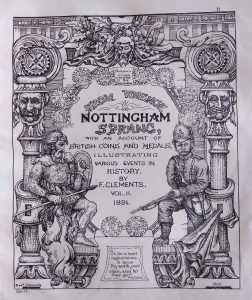 The book is an incredibly unusual publication, since rather than being a textual history with illustrations, as would have been common at the time, every single page is a drawing, with the text interspersed within it. It’s incredibly fresh and modern in feel – almost like a graphic novel, and yet the first volume was published in 1882 and the second in 1891!
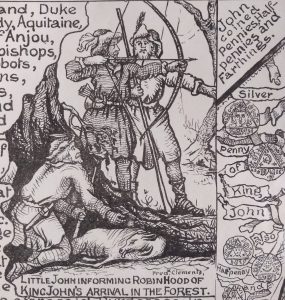 Events in the history of Nottingham are presented, together with some of the local legends, including the most famous one, of course! These are surrounded by blocks of text, and patterned borders, showing archaeological artefacts and sites related to the period of history being recounted. These accompaniments include numerous contemporaneous coins, drawn accurately with precision and skill, and often with notes indicating that the coins from which the illustrations were taken were in the collection of John Toplis, who wrote the book on 17th century tokens discussed above.
The author, Frederick Clements, lived between 1840 and 1921. He was a painter and decorator by trade, with a shop on Pepper Street in Nottingham. He was also very interested in the history and antiquities of the area. He was, for instance, one of the early researchers of the caves under the city, and illustrations of some of these appear in “From Whence Nottingham Sprang”. His suggestions for the age and uses of the caves are somewhat fanciful, and have subsequently mostly been disproved, but his interest in, and knowledge of, Nottingham’s history is evident in these amazing books. 60 sets of the books were printed, and 3 of those sets are currently at Bromley House – two in the permanent collection and one within the Michael Dobbin Collection, which is currently on long-term loan to the library.
All the books highlighted in this session are available for members to read in the library. They are kept in the locked cases in the main library room, so please ask a member of staff if you want to examine any of them (once the quarantine restrictions have been lifted and we’re back open!)
Anja Thompson-Rohde