
In 1904 Bromley House received a bequest of books from the estate of Philip James Bailey. Mr Bailey was a poet and philosopher, who was born in Nottingham in 1816. He is best remembered for his epic poem “Festus”, originally published in 1839, which was incredibly popular and influential during his lifetime, although largely forgotten today. In the last year of his life Mr Bailey was a member of the library, and when he died in 1902 he left us a number of his books. These volumes form the Philip James Bailey Collection, which is still available for library users to consult.
The collection naturally includes many works of poetry, written both by Bailey himself and by other authors. However, it also provides a fascinating insight into the owner’s curiosity and interests. Many of the books are religious in nature, and in fact Bailey originally studied to be a Presbyterian minister, although he didn’t pursue that calling. The works in his collection often focus on the philosophy of religion, a subject which comes through in his poetry, and there are also interesting volumes looking at more mystical and esoteric subjects, all of which seem to have contributed to Bailey’s own philosophy.
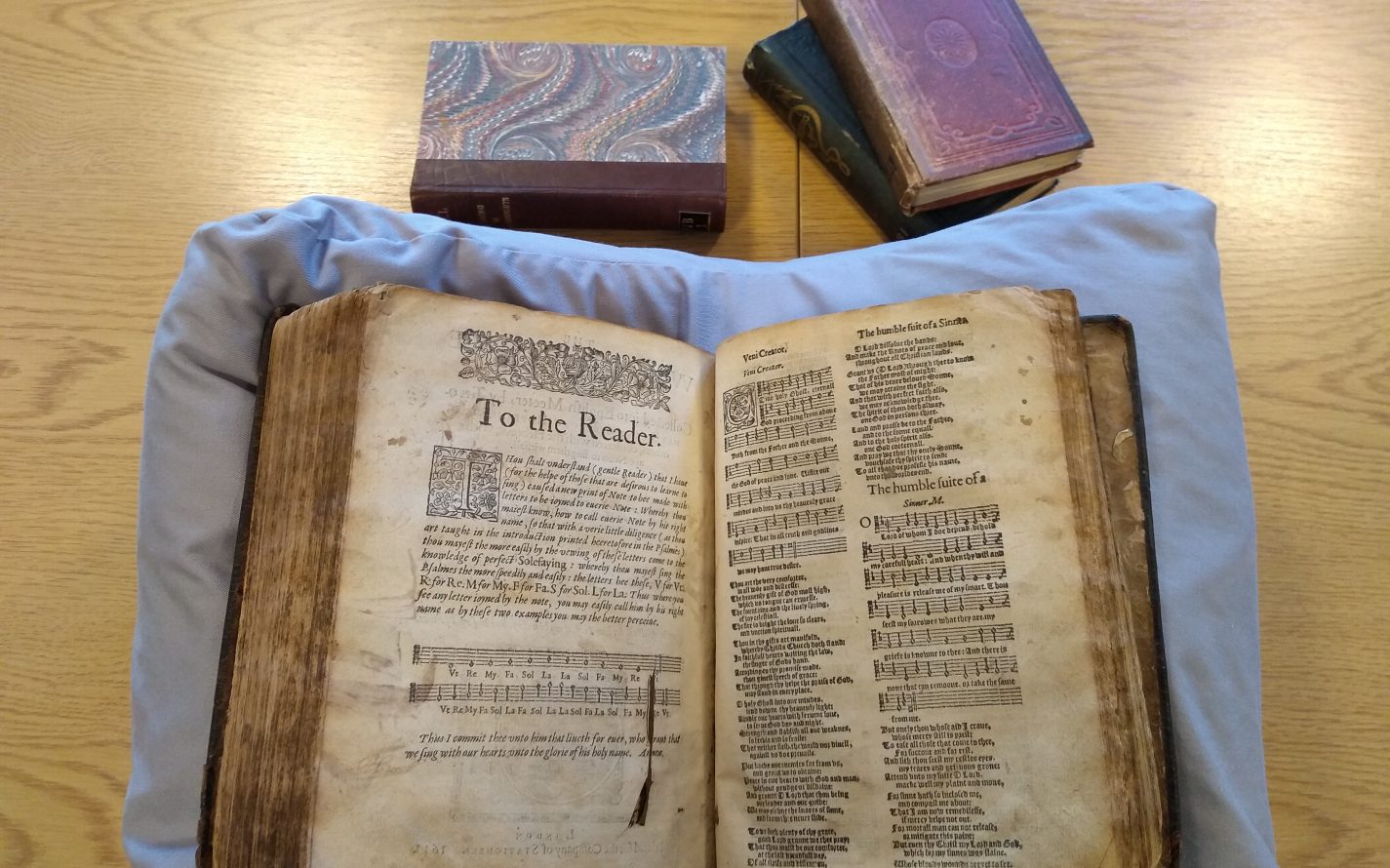
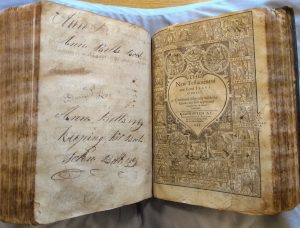
For the first of our new monthly ‘Spotlight Sessions’ I chose four of the books from the Bailey collection for members to see and examine. The first book is the oldest volume in the collection. It’s actually three works: The Book of Common Prayer, The Geneva Bible, and a Metrical Psalter. They were all published in 1610-11, and then bound together to form one volume. These three works were mainstays of the Anglican Reformation of the Tudor period, when England broke away from the Roman Catholic Church. They are written in English, rather than Latin, and include instructions for daily worship, and notations for singing the psalms, as well as the English bible. The book is also interesting for the information it includes about its previous owners. It has bookplates and signatures of various people who have owned it in the past, as well as notes and scribbles in the margins, and even little doodles of birds!
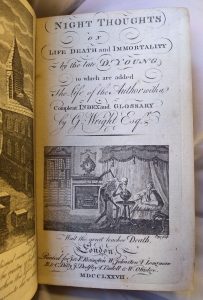 The second book is also religious, but from a more philosophical standpoint. “The Complaint, or Night-Thoughts on Life, Death & Immortality” was written by Dr. Edward Young in the 1740s. It is presented as a poem in sections, each representing one night of musing on religion and reason. This edition is from 1777 and includes a biography of the author. It also has a fantastically macabre picture on the frontispiece!
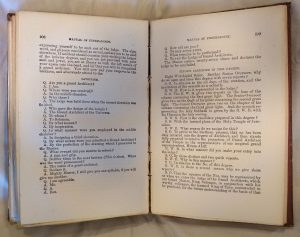
Bailey’s interest in mysticism and the arcane can be seen in the third book from the session. Author Richard Carlile is best known as a political and religious radical, who was imprisoned repeatedly in the early 19th century for publishing seditious and blasphemous works. In 1825 he began to write articles about masonic ritual, and these were gathered into a book in the 1830s. This “Manual of Freemasonry” was intended as an exposé of the secrets of the organisation and their use of pre-Christian pagan ritual, and was an instant bestseller amongst non-masons. However, Carlile did his research almost too well and the book quickly stopped being reviled by masons and actually began to be used within some masonic lodges as a guide for how to perform their rites! The book was constantly in print well into the twentieth century. This copy was published in 1860.
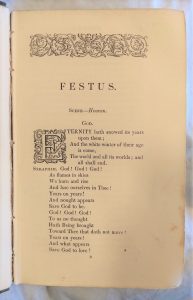 The final book is a copy of Bailey’s poem “Festus”. The poem is his English version of the story of Faust, and explores the possibilities of faith in combination with reason. It was written at his father’s home in Basford. Bailey reworked the poem repeatedly over his lifetime, adding many extra sections, such that the 50th anniversary edition, published in 1889, ran to over 40,000 lines! The Bailey Collection includes eight different editions of Festus, and this one is the second edition, from 1845.
The books in the Philip James Bailey Collection are not available for loan, but they can all be used and read within the library. Most of them are housed in the Thoroton Room, in their own bookcase to the right of the fireplace. They are listed in our online catalogue with the code PJB, and there is also a printed list of the books in a folder in the Thoroton Room. A few of them are kept locked away, but can still be used by members, so just ask us if you want to have a look at any of them!