

Hilary Mantel’s blockbuster The Mirror and the Light, the third novel in the Wolf Hall trilogy, was published in 2020 and won the Walter Scott Prize for Historical Fiction the following year. It charts Thomas Cromwell’s last four years, focusing closely on the dissolution of the monasteries and the sharing out of the spoils among Henry VIII’s courtiers and other nobles that inevitably followed. Mantel highlights the work of the “Court of Augmentations,” set up by Cromwell in 1536, whose commissioners valued and administered the confiscated properties, “busy turning monks into money,” according to one character in the novel. They kept meticulous records, later acquired by the Bodleian and Cotton Libraries, which are now in the National Archives.
In addition to the novel, Bromley House Library owns three editions of William Dugdale’s Monasticon Anglicanum, which made use of those records. They set out in considerable detail the entire list of dissolved monasteries, abbeys, priories, hospitals and cathedral and collegiate churches, together with their histories, possessions and values at the time of dissolution. First published in three volumes between 1655 and 1673, the Monasticon was subsequently translated from the Latin and expanded by other antiquarians. Dugdale was a Warwickshire scholar who, from 1638, began a career in the College of Arms, ending up as Garter Principal King at Arms.
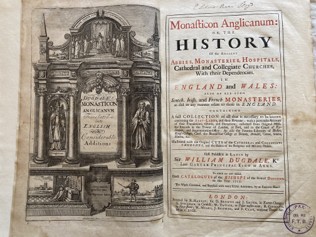
The library possesses a 1718 complete edition of the Monasticon and two additional volumes compiled by John Stevens in 1722-23. All three are lavishly illustrated and have been elegantly rebound. Interestingly, the bookplates in our copies indicate that they belonged at one time in the library of St Augustine’s Monastery in Ramsgate, the first Benedictine abbey to be established after the Reformation, in 1856
Mantel’s story, as one would expect, is meticulously researched. Many of the religious houses are mentioned and the reaction in the country to the work of the Augmentation Commissioners comes across strongly. In parts of the East Midlands, for example, there was considerable hostility, especially in Lincolnshire, where an uprising spread to Yorkshire and sparked the better-known rebellion, the Pilgrimage of Grace. Commissioners in Louth were attacked, and, in Horncastle, the Bishop’s man was bludgeoned to death. Lincolnshire was, in the King’s view, “one of the most brute and beastly shires in the realm.” He was advised to use Nottingham as a base to quell the uprising, but he relied on troops supplied by the Duke of Suffolk, Charles Brandon. He later acquired the lands of 30 monasteries.
In Leicestershire, the Augustinian abbey at Launde was a particular favourite of Thomas Cromwell. Mantel has him looking forward to a peaceful retirement there. It seems somewhat fitting, therefore, to read in the Monasticon that Cromwell’s son, Gregory, was awarded Launde and some of its rents and tithes for life, in the second year of Edward VI’s reign (1548). He had the benefit of Launde for only 3 years, however, dying there of sweating sickness in 1551. Its value at dissolution was £510. By comparison, the richest religious house in Nottinghamshire, the Cluniac Lenton Priory, was valued in the Monasticon at £410, 19 shillings and 3 pence.
The Augustinian Newstead Priory in Nottinghamshire, valued at £167, 16 shillings and 11½ pence in 1534, is listed as having been purchased after dissolution in 1539 by Hugh Willoughby, William Penyson and Sir John Byron. By 1540, the Byron family had assumed occupation and ownership. George Gordon, the sixth Baron, owned it from 1798 to 1818 but rarely lived there. He did live briefly in Southwell, however. The collegiate church in Southwell, which became a cathedral only in 1884, is depicted in a fine illustration. Its lands were seized by Edward VI.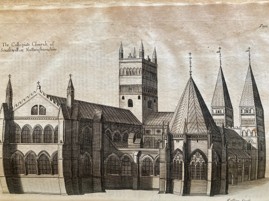
Dugdale’s Monasticon therefore allows a privileged look at the historical background to The Mirror and the Light and offers an insight into some of the local instances of suppression that took place in the 1530’s.
Hilary Mantel’s The Mirror and the Light can be reserved here
William Dugdale’s Monasticon Anglicanum, 1718 edition, Ccx 03863, and the Stevens 1722 – 23 editions, Ccx 03864 – 5, are not for loan but can be viewed by researchers and library members – an appointment will be required to facilitate this.