
In January 2012 the late Queen Elizabeth, by outliving the record-holder, deprived us all of a favourite quiz question ‘Who was the longest-lived British head of state?’ The surprising answer was Richard Cromwell, who held the office for less than a year, following the death of his father, Oliver. Even at the time his reign seems to have been considered a somewhat embarrassing mistake, best forgotten, as indeed he has been. He left the country on the restoration but after some twenty years in exile was allowed to return to the life of a country gentleman, surviving the reigns of his successors Charles, James, William & Mary before his death during the reign of Queen Anne.
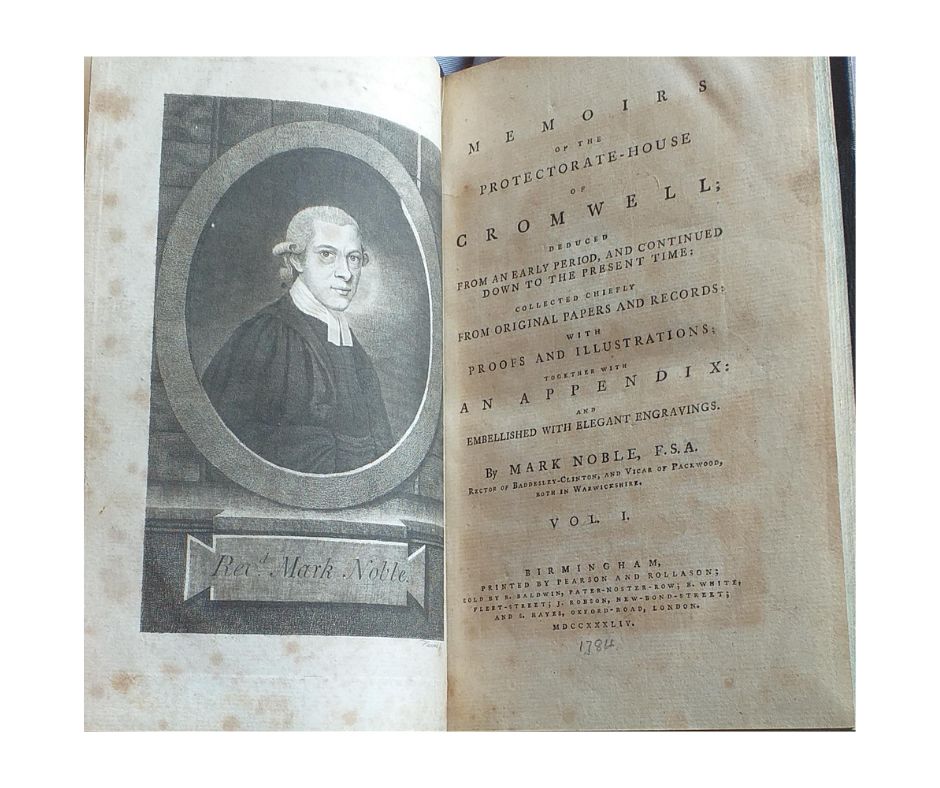
But a kinder appreciation of his life can be found in the attic; the antiquarian Mark Noble’s 1784 Memoirs of the Protectorate: Ca2108 and Ca2109
“The reader has seen one of the Cromwells, by an unparalleled revolution, ascend the throne of these kingdoms; he will here be presented with another, who, though he peaceably succeeded to the same grand elevation, fell from the giddy dream of grandeur, and left ‘not a wreck behind’ to any of his name or kindred.”
Richard took little part in the civil war “He is generally represented as dissatisfied with his father’s grandeur, as not thinking it built upon a good foundation, however that was, he did not hesitate a moment in accepting of part his honors, when he was declared his successor; the splendor of sovereignty, perhaps, was too glittering to be resisted.”
But in such fractious times and having, as was said by a contemporary (Bishop Gilbert Burnet) ‘neither genius nor friends, nor treasure, nor army to support him’, he was shortly deposed:
“… thus fell the house of Cromwell, from the sovereignty of one of the greatest nations upon earth, to the rank of private gentleman, without the loss of a drop of human blood, though such a deluge had been shed to raise it to that height.”
“Richard had not a single crime in his politic capacity to answer for; he was just such an usurper as lady Jane Grey.”
“He shewed a proper sensibility of the changeableness of the nation, when he was obliged to leave Whitehall , for giving strict orders to his servants to be very careful of two old trunks which stood in his wardrobe, it surprized a friend that was near, who asked what they contained, that he was so careful of them ‘Why’ replied he, ‘no less than the lives and fortunes of all the good people of England,’ The trunks were filled with the addresses sent from every part of the kingdom, expressing that the salvation of the nation depended upon his safety, and his acceptance of the sovereignty: these addresses he ever after carefully preserved” [perhaps as insurance, should his retirement be disturbed]
In conclusion the author directly compares this oft forgotten, but fundamentally decent man with one of Britain’s most iconic kings.
“There is a great similarity in the situations of Richard the protector, and king Henry V. at their accessions, both their fathers usurped the sovereign power but their dispositions were greatly different…” “… the former sacrificed relations and others to secure his government, which was no better than usurpation, and even involved another nation in blood to obtain a foreign crown: Richard would not put a single person to death to establish and secure a power, that all the nation had declared was his right; the hero and politician will certainly applaud the king, but the philosopher and the Christian will perhaps, be better pleased with the protector.”